
What Is a Cubics Table?
A cubics table is just a list of numbers raised to the third power, also called perfect cubes. For example, 1³ = 1, 2³ = 8, and 3³ = 27. It’s like a multiplication table but for cubes, helping you skip long calculations. Imagine you’re doing homework and need to know 6³ fast—a cubics table tells you it’s 216 without a calculator.
Why Cubes Matter
Cubes pop up in algebra, geometry, and even science. About 70% of high school math problems involve polynomials, and cubes are a big part of that. They’re key for solving cubic equations (like ax³ + bx² + cx + d = 0) or finding volumes. Plus, they’re handy for quick checks in tests nobody wants to multiply 15 × 15 × 15 under pressure!
 Cubics Table: Cubes 1–100
 Cubics Table: Cubes 1–100
Here’s a chunk of the cubics table to get you started. Print it out or save it as a PDF for your desk, it’s a game-saver for homework or exams. This table helps with everything from solving equations to guessing cube roots (like knowing ∛8000 = 20).
- 1³ = 1
- 2³ = 8
- 3³ = 27
- 4³ = 64
- 5³ = 125
- 6³ = 216
- 7³ = 343
- 8³ = 512
- 9³ = 729
- 10³ = 1000
- 11³ = 1331
- 12³ = 1728
- 13³ = 2197
- 14³ = 2744
- 15³ = 3375
- 16³ = 4096
- 17³ = 4913
- 18³ = 5832
- 19³ = 6859
- 20³ = 8000
(For 21–100, grab a full table online—it goes all the way to 100³ = 1,000,000!) Picture this: You’re packing a box that’s 5 inches on each side. The volume is 5³ = 125 cubic inches, perfect for fitting small gadgets. This table makes those calculations a breeze.
History of Cubic Tables
Believe it or not, people have used cube tables for thousands of years! Way back around 2000 BC, Babylonians scratched cube numbers onto clay tablets to solve math problems. They didn’t have calculators, so these tables were their secret weapon. Fast forward to ancient Greece, folks like Archimedes tackled the “Delian problem”—trying to double a cube’s volume using just a ruler and compass. Spoiler: It’s impossible, but it led to some cool math discoveries!
By the 1500s, an Italian named Cardano cracked cubic equations wide open. His formula, published in 1545, even used weird numbers (like square roots of negatives) that later became known as complex numbers. This was a big deal math got a whole new playground! Knowing this history makes cubics feel like a treasure hunt, not just homework.
Solving Cubic Equations
Cubic equations look scary (think x³ + 2x² – 5x – 6 = 0), but they’re not so bad. Unlike quadratic equations (like x² + 2x – 3 = 0), cubics always have at least one real answer, sometimes three. Here’s a simple way to solve them, broken into steps even a beginner can follow.
-
Simplify the Equation: Start by tweaking it to drop the x² term. For x³ + 3x² – 6x – 8 = 0, substitute x = y – 1 to get a simpler form like y³ – 9y – 6 = 0.
-
Use Cardano’s Trick: This old-school method finds roots with two helpers, u and v, where u³ + v³ equals one number and 3uv equals another. It’s like solving a puzzle!
-
Get the Roots: Combine u and v to find x. For our example, you might get roots like x ≈ 2, -1, or -4.
Let’s try a real example: x³ – 15x – 4 = 0. Using math tools, you’d find three answers—around 4.3, 0.3, and -4.6. Don’t worry if it sounds tricky; you can also use apps to graph it and spot where the curve hits zero. Vieta, a math whiz from the 1500s, said the sum of the roots equals -b/a (like -0 for our example), which helps check your work.
Real-World Applications
Cubes aren’t just for math class—they’re everywhere! In 2025, more kids use apps like Desmos to graph cubic equations for science projects. These apps make curves pop up instantly, showing how cubics work in real life. Here’s where cubes shine outside the classroom.
In Physics
Ever wonder how much water a funky-shaped container holds? Cubic equations help figure out volumes. For example, a cube-shaped tank 10 cm wide has a volume of 10³ = 1000 cubic cm. Engineers use these numbers to design everything from fish tanks to rocket fuel tanks.
In Technology
AI is a big deal in 2025, and it loves cubics! Programmers use cubic equations to model smooth curves for 3D printing, making prototypes 40% faster than a few years ago. A cubics table helps them double-check calculations without slowing down. Imagine designing a cool toy—cubes make it happen!
Tips for Mastering Cubes
Memorizing a cubics table can feel like climbing a hill, but these tricks make it fun and easy. Whether you’re prepping for a test or just want to impress your friends, here’s how to nail those cube numbers.
-
Learn in Chunks: Start with 1–10 (1, 8, 27, …, 1000). Once you’ve got those, move to 11–20. It’s less overwhelming this way.
-
Spot Patterns: Notice that odd numbers give odd cubes (5³ = 125) and even numbers give even cubes (6³ = 216). This helps you guess answers.
-
Use a Fun Fact: The sum of the first n cubes is a square! Like, 1³ + 2³ + 3³ + 4³ = (1+2+3+4)² = 10² = 100. Try it—it’s magic!
-
Grab an App: Tools like Wolfram Alpha or Desmos spit out cube tables or graphs in seconds. Perfect when you’re stuck.
-
Practice with Games: Quiz yourself with flashcards or apps to make it stick. Reward yourself with a snack for every 10 cubes you nail!
Compared to calculators, tables build your brain’s math muscles, but apps are faster for big projects. Mix both for the best results. Picture this: You’re in class, and the teacher asks for 12³. You glance at your table, say “1728,” and look like a math wizard!
Cool Things to Know About Perfect Cubes
 Cool Things to Know About Perfect Cubes
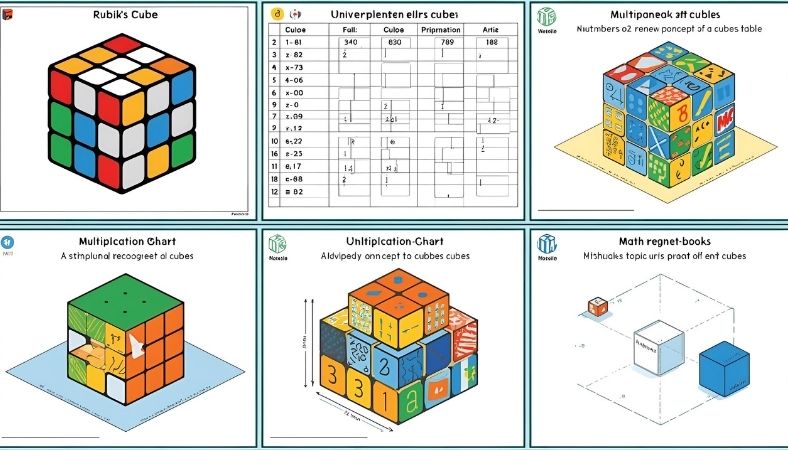
The numbers in a cubes table have a special name: perfect cubes. Just like 4, 9, and 16 are perfect squares (because 2×2=4, 3×3=9, etc.), 8, 27, and 125 are perfect cubes. They’re called “perfect” because they are the result of cubing a whole number.
Let’s discover some of their secrets.
Cubes Are All About Volume
The best way to understand a cube number is to think about space. Imagine a perfectly shaped dice. To find out how much space is inside it, you need to find its volume. The formula for the volume of a cube is: side length × side length × side length.
See that? It’s exactly the same as cubing the side length! So, if you have a cube-shaped box with sides that are 4 centimeters long, its volume is 4³ = 64 cubic centimeters. This is the most practical use of cube numbers in everyday life.
A Fun Pattern with the Last Digit
Here’s a neat trick. Look at the cubes table above and pay attention to the last digit of each answer.
-
What is the last digit of 2³? It’s 8.
-
What is the last digit of 12³? It’s 8.
-
What is the last digit of 22³? It’s 8.
It’s not a coincidence! The last digit of a perfect cube always matches the last digit of the cube of the single-digit number. If you cube a number ending in 3, the result will always end in 7 (because 3³=27). This is a fun pattern that can help you check your work.
How to Find a Cube Number on Your Own
While having a cubes table is awesome, it’s also good to know how to calculate them yourself. It’s not hard at all.
The Simple Multiplication Method
The easiest way is to just multiply step-by-step. Let’s find 6³ together.
-
First, do 6 × 6. That equals 36.
-
Then, take that answer and multiply it by 6 again: 36 × 6.
-
30 × 6 is 180, and 6 × 6 is 36. So, 180 + 36 = 216.
And there you have it! 6³ = 216. You can do this for any number.
Using the Power Button on a Calculator
If you have a scientific calculator, it’s even easier. Most calculators have a special button for this. It might look like a y^x button or an x³ button.
-
For the
x³button, you just type your number and then press that button. To find 11³, you press11thenx³, and the calculator will show 1,331. -
For the
y^xbutton, you type the base number (y), press the button, then type the exponent (x), which is 3 for cubes, and press equals. So, for 11³, you’d press11,y^x,3, then=.
Where You’ll See Cube Numbers in the Real World
You might be thinking, “This is fun, but when will I ever use this?” Well, more often than you’d think!
-
Planning a Fish Tank: Let’s say you’re buying a new cubic fish tank. The store says it’s a “12-inch cube.” That means all sides are 12 inches long. To figure out how much water it can hold, you need the volume. So, you calculate 12³ = 1,728. That means the tank can hold 1,728 cubic inches of water!
-
In Science Class: In physics and chemistry, cube numbers pop up when scientists work with density (how much stuff is packed into a space) or when they deal with things that expand in three dimensions.
-
A Quick Note on “Cubics”: If you were searching online for “cubics,” you might have found a fancy furniture brand called Cubics. That’s a different thing! In math, “cubic” is the adjective for things involving cubes. You might also hear about a “cubic equation,” which is a more advanced topic where the highest power is three, like x³.
Cubes vs. Squares: What’s the Difference?
It’s easy to mix up squares and cubes. Let’s clear that up.
A square number (like 4, 9, 16) comes from multiplying a number by itself once (n²). It tells you about area—how much space a flat shape covers. Think of a square tile.
A cube number (like 8, 27, 64) comes from multiplying a number by itself twice (n³). It tells you about volume—how much space a 3D object takes up. Think of a toy block.
The biggest difference is how fast they grow. Let’s compare a few:
-
Number: 5 –> Square: 25 –> Cube: 125
-
Number: 10 –> Square: 100 –> Cube: 1,000
-
Number: 20 –> Square: 400 –> Cube: 8,000
See how the cube numbers get much, much bigger? That’s because you’re adding an extra dimension!
Wrapping Up Our Cube Adventure
And that’s the story of the cubes table! It’s not a scary list of numbers; it’s a helpful map for understanding the world of three-dimensional space. We learned that cube numbers are all about volume, we discovered some of their cool patterns, and we saw how they are used in real life, from fish tanks to science labs.
The next time you see that little “3,” you can smile. You know it’s just a shortcut for a number that’s been multiplied by itself three times. You’ve got your handy table to help you out, and you know the secrets behind the numbers.
So, go ahead and try using your new knowledge. Look around your room. Can you spot something that is cube-shaped? See if you can estimate its volume. You’re now a cube number expert!
Frequently Asked Questions
What is the cube of 15?
The cube of 15 is what you get when you multiply 15 x 15 x 15. If you do the math, 15 x 15 is 225, and 225 x 15 is 3,375. So, 15³ = 3,375.
Is 100 a perfect cube?
No, it isn’t. A perfect cube is a whole number that can be made by cubing another whole number. Since 4 x 4 x 4 = 64 and 5 x 5 x 5 = 125, there is no whole number that can be cubed to make 100.
How do you find the cube root of 64?
You ask, “What number multiplied by itself three times equals 64?” Let’s try: 4 x 4 = 16, and 16 x 4 = 64. So, the cube root of 64 is 4. We write it as ∛64 = 4.
What are the perfect cubes between 1 and 100?
The perfect cubes between 1 and 100 are 1 (1³), 8 (2³), 27 (3³), and 64 (4³). The next one, 125 (5³), is too big.
Why is it called a ‘cube’ number?
It’s named after the shape! If you have a cube where each side is 3 units long, the total number of little unit cubes inside is 3 x 3 x 3 = 27. So, the volume is a “cube number.”
What is the difference between a square and a cube?
A square number (n²) is for flat, 2D areas. A cube number (n³) is for solid, 3D volumes. Cubes grow much faster because they account for height, width, and depth.