Carbon fibre filament promises the best of both worlds: parts that print as easily as everyday plastics but come out dramatically stiffer, stronger and more dimensionally stable. It’s the go-to material for functional brackets, drone frames, RC car parts and anything that needs to be light yet rigid. But carbon fibre filament (often written “carbon fiber filament” in American sources) demands respect. The same chopped fibres that reinforce your parts will chew through a brass nozzle in hours, sanding dust is not something you want in your lungs, and nylon-based versions drink moisture from the air. This guide covers what carbon fibre filament is, the hardened hardware it requires, sensible health and ventilation habits, and the temperatures, drying and storage practices behind great results.
What Carbon Fibre Filament Actually Is
Despite the name, carbon fibre filament isn’t woven carbon cloth — it’s a composite. Manufacturers mix short, chopped carbon fibres (typically 10–20% by weight) into a standard base plastic. The tiny fibres end up randomly oriented, which is why stiffness improves in all directions rather than just one.
The base plastic matters enormously, because it determines how hard the filament is to print:
- PLA-CF — carbon fibre in a PLA base. The easiest entry point: prints at normal PLA temperatures (210–240°C), needs no enclosure, and gives stiffer, more matte parts than plain PLA. It inherits PLA’s weaknesses though — low heat resistance (~55°C) and brittleness. Think “better-looking, stiffer PLA”, not an engineering material.
- PETG-CF — carbon fibre in a PETG base. Tougher and more heat-resistant than PLA-CF, still printable without an enclosure. Bambu Lab’s published settings call for 240–270°C and a 0.6mm hardened steel nozzle. The sweet spot for real functional gains without nylon-level hassle.
- PA-CF / PAHT-CF (nylon-based) — the serious engineering option: excellent strength, stiffness and heat resistance (heat deflection ~190°C+ for PAHT-CF), but demanding — high temperatures, very hygroscopic, enclosure strongly recommended.
- PET-CF, PPA-CF, PPS-CF — progressively more exotic bases (PPS-CF needs 310–340°C nozzles and a heated chamber). Fascinating, but beyond beginner territory.
Reality check: chopped fibres boost stiffness dramatically but don’t match woven carbon layup strength — and layer adhesion is often slightly worse than the unfilled base plastic, since fibres interrupt layer bonding. Orient critical loads along the layers, not across them.
Why Carbon Fibre Filament Eats Brass Nozzles
The non-negotiable rule, stated bluntly: do not print carbon fibre filament through a brass nozzle. Carbon fibres are effectively microscopic sandpaper flowing through your hotend. A brass nozzle’s orifice visibly enlarges within hours — sometimes within one long print — causing over-extrusion and ruined accuracy. It’s the most common and most avoidable carbon fibre mistake.
What you need instead:
- Hardened steel nozzle — mandatory. This is the baseline requirement from every manufacturer. Bambu Lab’s guidance for its carbon fibre filaments specifies hardened steel in 0.4, 0.6 or 0.8mm, with 0.6mm recommended to reduce clogging risk. Hardened steel resists the abrasion and lasts enormously longer than brass.
- 0.6mm nozzle preferred. The larger orifice is more forgiving: fibre clusters are less likely to jam, backpressure drops, and you can run wider line widths for stronger parts. If you only buy one hardened nozzle, make it a 0.6mm.
- Ruby-tipped nozzles — the premium option. A ruby orifice is harder still and lasts longer than hardened steel, at a higher price. Worth it if you print carbon fibre constantly; overkill for occasional use.
- Hardened extruder gears. The fibres don’t just attack the nozzle — they also wear the extruder’s drive gears and the filament path. If your printer has a standard brass or soft-steel extruder gear set, expect accelerated wear; hardened gears are a wise upgrade for regular CF printing.
If you’ve already run abrasive filament through brass, just replace the nozzle — a worn one looks fine but prints like a garden hose. Note that glow-in-the-dark, metal-fill and wood-fill filaments are abrasive too, so your hardened nozzle serves all of them.
Health and Ventilation: Printing Carbon Fibre Filament Safely
Printing releases two things worth thinking about: ultrafine particles (UFPs) from the melted plastic — common to all FDM printing — and potentially tiny fibre fragments during post-processing. Straight answer, no panic:
During printing
Normal printing doesn’t pulverise the fibres — they stay embedded in the molten plastic. The main emission is ultrafine particles from the heated polymer, similar to the unfilled base plastic. Sensible precautions:
- Print in a ventilated room, not a sealed bedroom. An open window — or better, an enclosure vented outdoors or through a filter — is the gold standard.
- Nylon-based CF (PA-CF, PAHT-CF) prints hotter and deserves more ventilation respect than PLA-CF. If you smell strong fumes, ventilate more.
- An enclosure does double duty: better quality for warp-prone CF nylons and contained emissions. Bambu Lab recommends enclosed printing for PET-CF; it’s effectively required for high-temp nylons.
Sanding, cutting and drilling — the real risk zone
Sanding, sawing or drilling a printed CF part does release fine dust containing carbon fibre fragments — a respiratory irritant. Treat it like any composite dust:
- Wear a proper respirator (P2/N95 or better) when sanding or cutting CF parts — a half-face respirator with P2 filters is the right tool.
- Wet-sand where possible. It keeps dust out of the air almost entirely and gives a better finish. Our guide to smoothing PLA prints covers the wet-sanding technique that works just as well on PLA-CF.
- Safety glasses and gloves, work outdoors or with extraction for big jobs, wipe surfaces with a damp cloth afterwards, and wash hands before eating.
None of this should scare you off — woodworkers manage nastier dust daily with the same precautions. Carbon fibre filament is a material to respect, not fear: ventilate the printing, respirate the sanding.
Printer Requirements: Hotend, Extruder and Enclosure
Beyond the hardened nozzle, run through this checklist before loading your first spool:
- All-metal hotend (for PETG-CF and above). PLA-CF is fine on a PTFE-lined hotend, but PETG-CF at 240–270°C is at the PTFE limit, and nylon-based CF at 260–290°C+ needs a genuine all-metal hotend — PTFE degrades above ~250°C. Can’t safely reach the temperature? Stick with PLA-CF.
- Hardened extruder gears and smooth filament path. Abrasive filament wears drive gears and carves grooves into soft path components. Hardened gears plus a clean, low-friction path prevent grinding and inconsistent extrusion.
- Enclosure — recommended, sometimes essential. PLA-CF doesn’t need one; PETG-CF benefits; nylon-based CF needs one for warping and layer adhesion. No enclosure? Don’t buy PA-CF yet.
- Dry filament path. CF nylons absorb moisture in hours — many makers print straight from a dry box or dryer via PTFE tube to the extruder.
- Bed adhesion. Textured PEI works well (65–75°C for PETG-CF, hotter for nylons). A thin glue stick layer aids release on smooth PEI — CF parts can bond too well.
If you’re weighing a printer upgrade partly for materials like this, it’s worth looking at machines built for engineering filaments from the start — our roundup of the best dual-extruder 3D printers for 2026 covers options with the hardened, high-temp toolheads that handle abrasive filaments properly, plus the second extruder is handy for soluble supports on complex CF parts.
Drying and Storage: Carbon Fibre Filament Hates Moisture
Moisture management separates successful carbon fibre printing from misery. Nylon-based CF is among the most hygroscopic materials in 3D printing — crisp to useless in a humid room within a day or two. Wet CF nylon hisses, foams, and bonds terribly. PLA-CF and PETG-CF are far more forgiving but still like dry storage.
- Dry before first use. Assume new PA-CF needs it: 75–85°C for 8–12 hours in a filament dryer. PETG-CF: ~65°C for 8 hours. PLA-CF: 50–55°C for a few hours.
- Store sealed with desiccant. Sealed bags or dry boxes with rechargeable silica gel, under 20% relative humidity.
- Print from the dryer for nylons. Feeding PA-CF/PAHT-CF directly from an active dryer during the print is standard practice — they reabsorb moisture mid-print in humid air.
- Never microwave-dry or use a kitchen oven. Crude temperature control risks melting the spool or degrading the filament. Use a purpose-built dryer.
For the complete picture of what each material needs, Bambu Lab publishes an official filament guide (PDF) comparing properties, drying requirements and print settings across their whole range including the carbon fibre filaments — it’s a handy reference even if you don’t own a Bambu machine.
Temperatures, Speeds and Warping Tips
Carbon fibre filaments reward a slightly different approach in the slicer than their unfilled cousins. These are starting points — always check your specific spool’s label first:
- PLA-CF: 210–240°C nozzle, 35–45°C bed, print at normal PLA speeds. Bambu’s guidance caps speed under 200mm/s. Cooling fan on, as with PLA.
- PETG-CF: 240–270°C nozzle, 65–75°C bed, under 200mm/s. Slightly hotter than plain PETG helps the fibres wet out and improves layer bonding. Keep the part cooling fan moderate — too much cooling hurts layer adhesion on filled materials.
- PAHT-CF / PA6-CF: 260–290°C nozzle, 80–100°C bed, under 100mm/s, cooling fan low or off. Slow down — these materials need time for layers to fuse, and speed is the enemy of strength here.
- Retraction: keep it gentle. Brittle filled filaments don’t like aggressive retraction — short distances (0.5–1.5mm on direct drive) at moderate speeds prevent the extruder chewing the filament.
- First layer: a touch slower and slightly squished. CF filaments can be less forgiving of a marginal first layer, so nail your Z offset and bed cleanliness.
- Warping: the fibres actually reduce warping compared to unfilled nylon — one of their genuine benefits — but PA-CF still warps without an enclosure. Brims help; drafts are the enemy. PLA-CF and PETG-CF barely warp at all.
One more slicer tip: carbon fibre filaments hide layer lines beautifully thanks to their matte, slightly textured finish. That means you can often print at 0.2mm or even 0.28mm layer heights and still get great-looking parts — bigger layers mean stronger parts and faster prints, a rare win-win.
When Carbon Fibre Filament Makes Sense — and When It Doesn’t
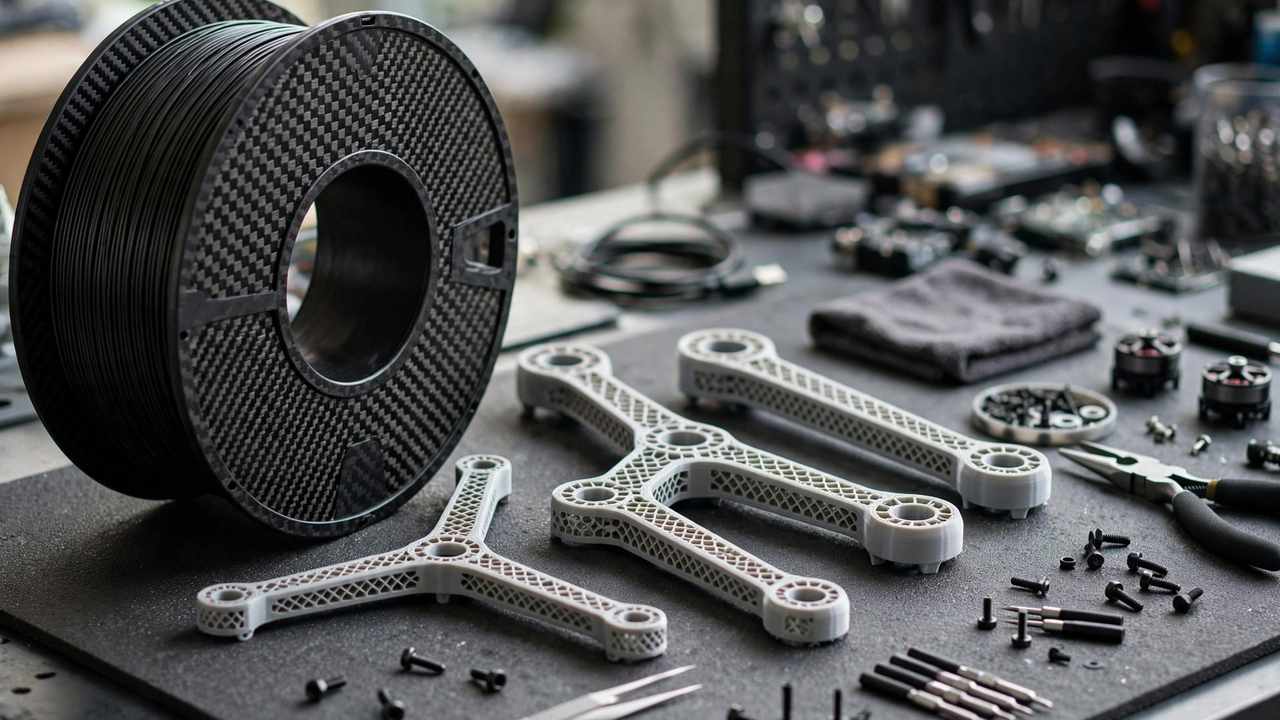
Carbon fibre filament earns its place for functional parts where stiffness matters: drone frames and arms (stiff arms mean stable flight), RC car suspension and chassis parts, robotic brackets, camera rigs, jigs and fixtures. The matte finish suits parts that should look technical rather than toy-like.
It does not make sense for: decorative prints (paying a premium for unneeded stiffness — plain PLA looks better and prints easier), parts needing impact toughness above all (CF composites are stiff but not especially impact-resistant; unfilled PETG or ASA often survives drops better), or food-contact items.
Expect roughly two to four times the price of plain PLA per kilo. Use carbon fibre filament where its properties pay off, plain materials everywhere else — your wallet and nozzle will thank you.
Frequently Asked Questions
Can I print carbon fibre filament with a brass nozzle?
No — not if you value the nozzle. Carbon fibres are highly abrasive and will enlarge a brass nozzle’s orifice within hours, causing over-extrusion and ruined dimensional accuracy. A hardened steel nozzle (0.6mm recommended) is mandatory, and hardened extruder gears are strongly advised for regular use. Ruby-tipped nozzles are the premium long-life option.
Is carbon fibre filament toxic to print?
During printing the fibres stay embedded; emissions are mainly ultrafine particles like the unfilled base plastic. Ventilate the room or use a filtered enclosure. The real caution is post-processing: sanding or cutting releases fibre dust — wear a P2/N95 respirator, wet-sand where possible, and use glasses and gloves.
Does carbon fibre filament need an enclosure?
PLA-CF does not need an enclosure. PETG-CF benefits from one but prints acceptably open-frame. Nylon-based carbon fibre filaments (PA-CF, PAHT-CF) effectively require one — they warp badly in drafts and need the warm, stable chamber for good layer adhesion. Match the enclosure to the base plastic, not the fibres.
How do I dry carbon fibre filament?
Nylon-based CF is very hygroscopic: dry at 75–85°C for 8–12 hours in a filament dryer or forced-air oven before use, store sealed with desiccant below 20% humidity, and consider printing directly from the dryer. PETG-CF needs around 65°C for 8 hours; PLA-CF is fine at 50–55°C for a few hours. Never dry filament in a microwave or kitchen oven.
Is carbon fibre filament stronger than regular PLA?
It is dramatically stiffer than regular PLA, which is what most people mean — parts flex far less under load. But “stronger” needs care: chopped fibres can slightly reduce layer adhesion (Z-axis strength) compared to the unfilled plastic. For maximum real-world strength, orient loads along the layers, use adequate walls, and choose the right base plastic (PETG-CF or PA-CF) for genuinely hard-working parts.
What is the difference between PLA-CF, PETG-CF and PA-CF?
The difference is the base plastic the chopped carbon fibres are mixed into. PLA-CF is the easiest to print but has PLA’s low heat resistance. PETG-CF is tougher and more heat-resistant — the sweet spot for most functional prints. PA-CF (nylon-based) is the true engineering material with the best strength and heat resistance, but it needs high temperatures, an enclosure, hardened hardware and rigorous drying.