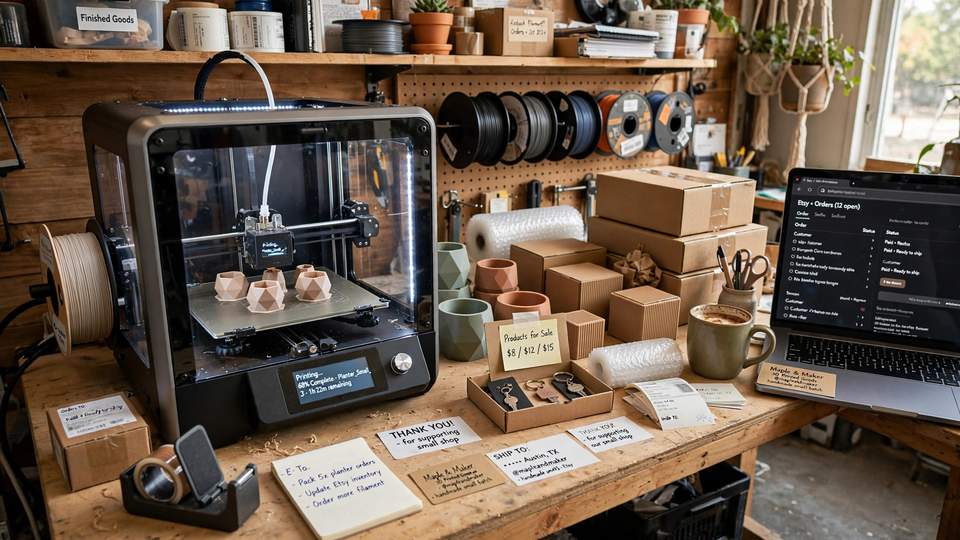
So your 3D printer has gone from hobby to income stream — Etsy orders trickling in, a few regular clients for custom parts, maybe a market stall on weekends. Congratulations! Now comes the part nobody finds exciting but everybody needs: 3D printing side hustle tax in Australia. Get it right and it’s just paperwork; get it wrong and the ATO’s data-matching systems will find you. This guide explains 3D printing side hustle tax Australia rules in plain English — what the ATO expects, what you can claim, and the traps that catch makers.
This guide explains the hobby-versus-business distinction that determines everything, when you need an ABN, the GST threshold, what deductions you can claim on printers and filament, and the record-keeping habits that keep you safe. Important: this is general information for makers, not personal tax advice — talk to an accountant about your specific situation.
3D Printing Side Hustle Tax Australia: Hobby or Business?
The ATO doesn’t care whether you enjoy your 3D printing (the “enjoyment test” is a myth). What matters is whether you operate like a business. The ATO weighs six factors:
- Intention to profit: Do you intend to make a profit, even if you haven’t yet? A business doesn’t need to be profitable — just profit-intended.
- Repetition and regularity: Regular, repeated sales look like a business. Occasional one-offs to friends look like a hobby.
- Business-like operation: Records, invoices, a separate bank account, a business plan, marketing — these are business signals.
- Scale: Larger, more organised activity looks more like a business.
- Planning and systems: Do you plan production, manage inventory, track costs?
- Commercial manner: Selling to the public at market prices vs giving things to mates at cost.
The practical test for 3D printing: printing the occasional gift for a friend = hobby. Running an Etsy shop with listings, pricing, regular orders, and Instagram marketing = business, even if you love every minute of it.
Why it matters: hobby income generally isn’t taxable — but you can’t claim deductions either. Business income is taxable, but you can deduct every genuine expense. And only a business (an “enterprise” in GST law) can register for GST and claim GST credits.
Do You Need an ABN?
If your 3D printing is a business, you should get an Australian Business Number (ABN). It’s free, there’s no ongoing cost, and you can cancel anytime. Without an ABN, businesses you sell to must withhold 47% of payments to you — which instantly makes you uncompetitive for B2B work like prototyping for local firms.
Apply at abr.gov.au. Sole trader is the right structure for most side hustles starting out — simple, cheap, and your business income just goes on your personal tax return.
The GST Threshold: $75,000
You must register for GST once your business turnover reaches $75,000 in a 12-month period. Below that, registration is optional — but think carefully:
- Not registered: Simpler BAS-free life, but you can’t claim GST credits on your printer, filament, and equipment purchases. That shiny AU$1,500 printer effectively costs you ~AU$136 in unclaimable GST.
- Voluntarily registered: You charge 10% GST on sales and claim credits on purchases, but you must lodge BAS statements (usually quarterly). Worth it if you have significant equipment expenses.
Most 3D printing side hustles sit well under the threshold for years. But watch it — a good year with a couple of commercial contracts can sneak up on you, and the ATO expects registration within 21 days of becoming aware you’ll exceed it.
3D Printing Side Hustle Tax Australia: What Can You Deduct?
Once you’re operating as a business, genuine expenses connected to earning income are deductible:
- Equipment: 3D printers, wash/cure stations, dryers. Items over $300 are depreciated over their effective life; under $300 can often be claimed immediately.
- Consumables: Filament, resin, IPA, replacement nozzles, build plates, FEP films — all deductible as cost of goods sold or consumables.
- Electricity: The business portion of power for printing. A plug-in power meter (AU$20-30) gives you defensible numbers — printers draw 100-300W, and it adds up over hundreds of print hours.
- Home office: The ATO fixed-rate method for 2025-26 is 70 cents per hour for working from home. Keep a diary of hours.
- Vehicle: Deliveries and market trips — 88 cents per kilometre for 2025-26 (capped at 5,000 business km), or logbook method for actual costs.
- Platform fees: Etsy fees, eBay final value fees, PayPal/Stripe charges.
- Software: CAD subscriptions, slicer donations, website hosting, domain registration.
- Marketing: Photography equipment, advertising spend, market stall fees.
- Professional fees: Your accountant’s fee is deductible too.
For pricing your work to actually cover these costs, see our how to price 3D printed products guide — and for revenue ideas, 3D printing business ideas and making money with your 3D printer.
Record-Keeping: The ATO Expects 5 Years
For 3D printing side hustle tax Australia purposes, the ATO generally expects you to keep records for five years. For a 3D printing business, that means:
- All sales records — platform reports, invoices, receipts
- All expense receipts — filament orders, equipment, everything
- Home office hour diary
- Vehicle logbook or kilometre records
- Bank statements showing business transactions (use a separate account — it makes everything easier)
Practical system: a separate bank account + a simple spreadsheet (or free accounting app) updated weekly. Fifteen minutes a week beats a shoebox of receipts in June.
The ATO Is Watching (Data Matching)
Don’t assume small online sales fly under the radar. The ATO’s data-matching programs are extensive:
- Over 600 million transactions are reported to the ATO each year from banks, payment systems, and platforms.
- The online selling data-matching program specifically tracks sellers with annual trading activity of $12,000 or more on platforms like eBay and Amazon.
- Sharing-economy reporting regimes now pull data directly from digital platforms.
Under-reporting income is the single most common side-hustle tax mistake — and the easiest for the ATO to detect. Declare everything; the deductions usually make the tax bill smaller than people fear.
Three Traps That Catch Makers
When it comes to 3D printing side hustle tax Australia compliance, these are the mistakes the ATO sees most often:
- Under-reporting income: Platforms report to the ATO. If your Etsy 1099-equivalent says $18,000 and your return says $4,000, expect questions.
- Over-claiming deductions: That printer you use 90% for hobby prints and 10% for paid work? You can only claim the 10%. Be honest about apportionment.
- Crossing $75,000 without registering for GST: The liability (GST you should have collected) falls on you. Monitor turnover quarterly.
Getting Started: Your Action Checklist
- Decide honestly: hobby or business? (Use the six factors above.)
- If business: apply for an ABN (free, abr.gov.au).
- Open a separate bank account for the hustle.
- Start a simple income/expense spreadsheet — today, not in June.
- Set aside 20-30% of profit for tax so you’re never caught short.
- Track home-office hours and vehicle kilometres from day one.
- Calendar a quarterly turnover check against the $75,000 GST threshold.
- Talk to an accountant before your first tax return as a business — one session prevents expensive mistakes.
Case Study: Maya’s Journey From Hobby to Business
(Composite example based on common maker experiences — not a real person.)
Maya bought an Ender 3 in 2023 for fun. By mid-2024 she was selling planters at a local Brisbane market — AU$200-300 most weekends. Here’s how her tax situation evolved:
- Phase 1 — Hobby (first 6 months): Occasional sales to friends, no marketing, pricing barely covered filament. Genuinely a hobby — no tax obligations, no deductions.
- Phase 2 — Transition (months 6-12): Monthly market stall, Instagram page, consistent pricing with real margins. This is where it became a business in the ATO’s eyes — regular, marketed, profit-intended.
- Phase 3 — Business (year 2): Got an ABN (free, 15 minutes online). Opened a separate bank account. Started tracking every expense. Bought a second printer — claimed as a business asset. Annual turnover ~AU$18,000, well under the GST threshold.
- The numbers: AU$18,000 revenue minus AU$6,500 in deductions (filament, second printer depreciation, market fees, home office hours, mileage) = AU$11,500 taxable business income, added to her day-job salary on her tax return. Her accountant’s AU$350 fee was itself deductible.
Maya’s key insight: “I wish I’d started the spreadsheet on day one. Reconstructing a year’s expenses from bank statements in June was miserable.”
Your Quarterly Tax Calendar
Put these in your calendar and tax becomes routine instead of a June panic:
- July: New financial year. Review last year’s return with your accountant. Set your tax savings target (20-30% of expected profit).
- October: Q1 check — is turnover tracking toward $75,000? Review expenses YTD. Back up all records.
- January: Q2 check. Mid-year profit review — adjust your tax savings if income is higher than expected.
- April: Q3 check. Start gathering anything missing for end-of-year. Confirm GST position.
- June: End of financial year. Final expense reconciliation. Prepay deductible expenses if cashflow allows (accountant will advise).
- July-October: Lodge your return. If using a tax agent, the deadline extends to May the following year — but don’t use that as an excuse to procrastinate.
State-by-State: Anything Different?
Australia’s tax system is federal, so the core rules (income tax, GST, ABN) are the same nationwide. But a few state-level things can touch your 3D printing hustle:
- Market stall permits: Council permits and fees vary enormously — from free community markets to AU$200+ per stall at major city markets. Factor this into pricing.
- Business names: If you trade under a name other than your own (e.g., “Brisbane 3D Prints”), register it with ASIC — AU$44 for one year or AU$102 for three years (current fees).
- Home business rules: Some councils restrict home-based businesses regarding signage, customer visits, and noise. A 3D printer farm running overnight might breach residential noise rules — check your local council.
- Insurance: Public liability for market stalls is often required by market organisers (usually AU$10-20M cover, ~AU$300-500/year through small business insurers).
When to See an Accountant
DIY is fine for simple sole-trader hustles, but see an accountant when: turnover approaches $75,000; you take on employees or contractors; you want to explore company structures; you’re unsure about hobby vs business classification; or the ATO contacts you about anything. A AU$300-500 annual accountant fee is deductible and routinely pays for itself in avoided mistakes and found deductions.
Free Resources Worth Bookmarking
- ato.gov.au: The authoritative source for everything — searchable, with specific pages for hobby vs business, GST registration, and deductions.
- ABR (abr.gov.au): Free ABN application, typically processed quickly for straightforward sole-trader applications.
- ASIC (asic.gov.au): Business name registration.
- Business.gov.au: Federal government’s plain-English business guides, including starting-a-business checklists.
- Your state revenue office: For payroll tax and duties questions if you scale up (unlikely to matter for side hustles, but good to know).
Bookmark these now. When a tax question comes up at 10pm, the official source beats a random forum thread every time.
Remember: The goal isn’t to pay zero tax — it’s to pay the right tax while claiming everything you’re legitimately entitled to. Makers who keep good records, declare honestly, and get professional advice when needed sleep well at tax time. Those who wing it… don’t. Start your records today.
Frequently Asked Questions
Do I pay tax on 3D printing hobby income?
Genuine hobby income generally isn’t taxable — but you can’t claim deductions either, and you don’t need an ABN. The moment it becomes regular, marketed, and profit-intended, it’s a business.
When do I need to register for GST?
When turnover reaches $75,000 in 12 months. Below that it’s optional. Register within 21 days of realising you’ll exceed the threshold.
Can I claim my 3D printer as a tax deduction?
If it’s used for business, yes — apportioned to business use. Items over $300 are depreciated; consumables like filament are deducted as you use them.
How long must I keep tax records?
Five years, generally. Keep sales records, expense receipts, hour diaries, and logbooks.
Does the ATO know about my Etsy sales?
Almost certainly, if they’re material. The ATO’s data-matching covers platforms, banks, and payment systems — over 600 million transactions a year, including an online-selling program tracking $12,000+ sellers.
This article is general information only, not personal tax advice. Tax law is complex and individual circumstances vary — consult a registered tax agent or accountant before making decisions. The authoritative source is always ato.gov.au.