
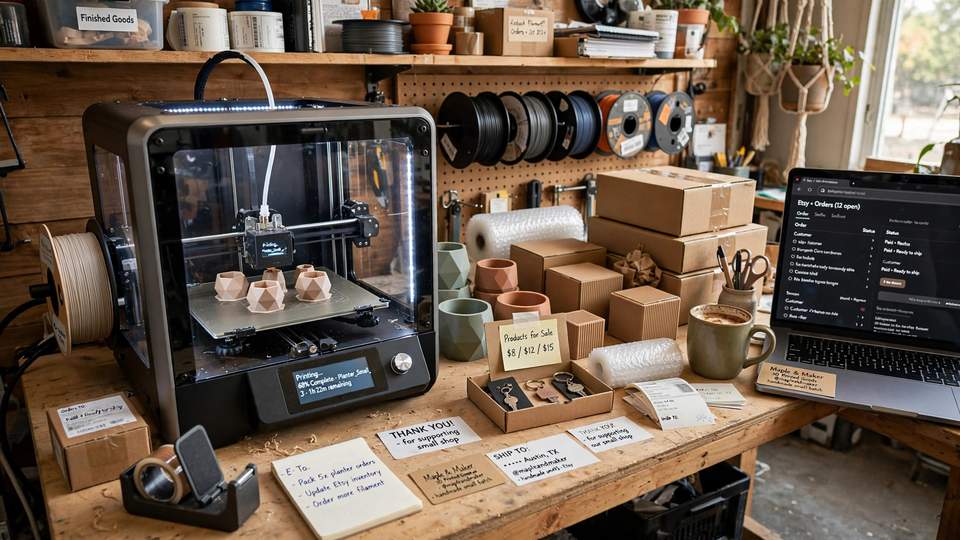
This guide rounds up 12 3d printing business ideas Australia makers are genuinely using right now — with realistic startup costs in AUD, the ABN and tax basics you need before selling anything, a pricing formula that keeps you profitable, and a straight-talking look at the competition. No hype, no invented success stories.
Can you actually make money with a 3D printer in Australia?
Yes — but let’s set expectations before the ideas. The money isn’t in generic products. Dragons, planters and phone stands are saturated; you’ll be competing with sellers happy to earn pennies and with cheap imports you can’t beat on price. Where Australians actually make it work: custom and personalised products, local services (where fast turnaround beats overseas shipping), and B2B work for businesses that need parts or models.
Your structural advantage as a local maker is simple: an overseas seller takes two to four weeks to deliver and can’t customise a thing. You can have a made-to-measure part in a customer’s hands by the weekend. Lean into that — speed, customisation and the ability to iterate on feedback are things no container ship can match.
Realistic numbers: most side-hustle makers earn a few hundred to a couple of thousand dollars a month once established. Full-time income is possible but takes years, multiple revenue streams and genuine design skills. If you haven’t bought a machine yet, start with our roundup of the best FDM 3D printers in Australia — most of the ideas below run best on filament machines.
The boring-but-essential setup: ABN, business names and tax
Before you sell a single print, sort the paperwork. It’s cheaper and faster than most people expect.
- Get an ABN. Applying for an Australian Business Number is free through the Australian Business Register (business.gov.au walks you through it). Without one, businesses that buy from you may be legally required to withhold tax from your payments, and you look far more legitimate quoting one on invoices.
- Register a business name — maybe. If you trade under your own name, you don’t need one. If you trade as anything else (“Brisbane 3D Prints”), register it with ASIC: $47 for one year or $108 for three years (fees from 1 July 2026). Here’s a clear breakdown of the business name registration process and fees if you want the details.
- GST can wait. You only need to register for GST once your turnover hits $75,000 a year. Most starters are nowhere near that.
- Keep records from day one. Save receipts for the printer, filament, packaging and market stall fees. Declare the income at tax time. This isn’t tax advice — when the money gets serious, a one-off chat with an accountant pays for itself.
- Check market insurance. Many weekend markets require public liability insurance from stallholders. Factor it into your costs before booking a stall.
Not every idea on this list suits every maker, but all of these 3d printing business ideas australia can support have been chosen because they work with local demand, local pricing, and realistic startup budgets.
What it costs to start a 3D printing business in Australia
One of the best things about this side hustle is the low barrier to entry. A realistic startup budget:
| Item | Typical AUD cost |
|---|---|
| Decent FDM printer | $300–$500 |
| Budget resin printer (for miniatures/jewellery niches) | $180–$650 — see our best budget resin 3D printers in Australia roundup |
| Filament (PLA) | $20–$40 per kg |
| Resin | $33–$40 per kg |
| Tools: digital calipers, glue, sandpaper, packaging | $50–$100 |
| ABN | Free |
| Business name registration (optional) | $47 |
All up, $500 to $1,500 gets most people properly started — printer, materials, tools and paperwork. That’s less than a decent laptop, and unlike most businesses there’s no rent, no staff and no inventory until someone actually orders.
12 3D printing business ideas Australia actually supports
Each of these has real demand locally. Pick one, get good at it, and expand from there — the makers who try all twelve at once usually master none of them.
1. Cosplay props and costume pieces
Australia’s convention scene — Supanova, PAX Aus and the rest — runs on props, and good ones aren’t cheap. FDM printers handle helmets, swords and armour pieces beautifully. The money is in the finishing: a raw print sells for little, but a sanded, painted, weathered prop commands $80 to $400+. If you can paint, this is one of the highest-margin niches going.
2. Tabletop gaming miniatures and terrain
A natural fit for resin printers. Gamers constantly want custom warbands, terrain sets and replacement bits. Sell painted or unpainted, offer local game stores consignment stock, or take commissions. One hard rule: don’t print and sell licensed designs (Games Workshop, Wizards of the Coast) — that’s copyright infringement and it will catch up with you. Original or properly licensed designs only.
3. Custom cookie cutters and cake toppers
Cheap to produce, endlessly personalisable, and always in demand for birthdays and weddings. A cutter costs cents in filament and sells for $8–15. One caution: standard PLA isn’t certified food-safe, so look into current food-safety guidance for 3D printed items before selling cutters — many sellers include care instructions and single-use recommendations.
4. Replacement parts for broken things
Dishwasher rack clips, vacuum cleaner latches, vintage car knobs, obscure appliance feet — the world is full of small plastic parts manufacturers stopped making decades ago. Customers find you through Facebook Marketplace and local community groups, often searching in desperation. The perceived value is huge: a 50-cent print that saves a $400 appliance sells easily for $15–30.
5. Wedding and event décor
Personalised signage, table numbers, cake toppers, place-card holders — couples pay well for custom pieces and order in bulk. It’s seasonal (spring and autumn are peak), but a few weddings a month can match a part-time wage. Partner with local event stylists and photographers who’ll recommend you.
6. Architectural and display models
Architects, real-estate agents and uni students all need physical models, and 3D printing beats balsa wood on both speed and detail. This is B2B: fewer customers, higher prices, professional expectations. One good relationship with a local architecture firm can mean repeat work for years.
7. Lithophanes and personalised photo gifts
Lithophanes — photos printed as thin panels that reveal the image when backlit — make stunning personalised gifts. Material cost is tiny; the value is all in the customisation. Demand spikes around Mother’s Day, Father’s Day and Christmas, so plan your marketing calendar around them.
8. Pet accessories and aquarium decorations
Personalised pet ID tags, custom tank ornaments, reptile hides — pet owners and aquarium hobbyists spend freely on their animals. Aquarium decorations are a sleeper niche: use aquarium-safe materials, design original pieces, and you’ll find a passionate audience with little local competition.
9. Drone, RC and hobby parts
Crash damage is a way of life in the RC world, and replacement parts are often slow to arrive from overseas. Print arms, mounts, guards and adapters in tough materials like PETG or TPU. Local clubs and Facebook groups are your marketplace — be the person who can have the part ready by the weekend.
10. Prototyping for local inventors and startups
The highest hourly rates in this list. Inventors, uni students and small businesses need prototypes but can’t justify industrial 3D printing services. If you can do basic CAD work, charge for design time plus print time. You’re selling expertise, not plastic — and expertise isn’t competing with $5 imports.
11. Jewellery and lost-wax casting patterns
Resin printers can produce the ultra-detailed wax-like patterns jewellers cast into metal. This is a genuine professional niche with excellent margins — but be honest with yourself about the skill curve. You’ll need to understand castable resins, work with a casting house (or learn casting), and produce flawless patterns. Not a beginner project, but a serious business for those who master it.
12. Selling digital STL files
Design once, sell forever. Marketplaces like Cults3D, MyMiniFactory and Etsy let you sell digital designs with zero inventory, zero postage and zero print failures. The catch: it takes time to build a catalogue and reputation, and your designs need to be genuinely good — the free alternatives are excellent. Think of it as a slow-building second income stream alongside physical products.
Pricing 3D printing business ideas Australia: a formula that works
Most beginners undercharge because they only count filament. Here’s a formula that keeps you profitable:
Price = (material cost + machine time + your labour + overheads) × 1.2 margin
A worked example — a custom cosplay dagger:
- Material: 150g PLA at $28/kg = $4.20
- Machine time: 7 hours at $2.50/hr = $17.50 (covers power, wear and failed prints)
- Labour: 40 minutes finishing and packing at $35/hr = $23.30
- Overheads: packaging, fees allowance = $5.00
- Subtotal: $50 → sell at $60
Two pricing truths. First, your time is the biggest cost — never price at “filament plus a bit”. Second, if you sell on Etsy Australia, factor in the fees: 6.5% transaction fee on the item price plus shipping, plus 3% + A$0.25 payment processing on domestic orders (check Etsy’s current fee page, as rates change). And never try to compete on price with mass-produced imports — compete on customisation, local turnaround and quality instead.
Pick one idea, validate it with a small test batch, and scale what sells. These 3d printing business ideas australia makers are already using prove there’s real money in the hobby.
Where to sell these 3D printing business ideas in Australia
Start with one channel and do it well:
- Etsy Australia — the biggest audience for handmade and custom goods, but crowded. Great for personalised products; factor the fees into every price.
- Facebook Marketplace — free to list, local pickup, perfect for replacement parts and bulky items you’d rather not post.
- Weekend markets — brilliant for testing products and getting instant feedback. Check the market’s insurance requirements first.
- Your own website — best margins and full control, but you’re also the entire marketing department. Worth it once you have repeat customers.
- Direct B2B — architects, tradies, event planners, game stores. Fewer sales, bigger orders, no platform fees.
For more on turning prints into income, see our broader guide to making money with a 3D printer in Australia.
Getting noticed without a big budget
Marketing a print business costs time more than money. Photograph everything in daylight against a plain background — phone photos are fine if the lighting’s good. Post process videos on TikTok and Instagram; people love watching prints come off the build plate, and a single viral clip can fill your order book for a month. Join local Facebook groups for your niche (cosplay, aquariums, RC) and be genuinely helpful before you sell — regulars who trust you become repeat buyers. And if you serve local customers, a free Google Business Profile puts you on the map — literally.
The honest downsides nobody mentions
- Generic products are saturated. If it can be described in three words (“dragon desk toy”), a hundred sellers already list it.
- Failures eat margins. Quote with a buffer for reprints — a 10-hour print that fails at hour nine still cost you filament and power.
- Resin sellers, take note: only ever sell fully washed and cured prints, and never ship anything containing uncured resin or liquid chemicals.
- Copyright is real. Printing and selling licensed characters — Pokémon, Disney, Warhammer — can get your listings removed and your accounts banned. Design original work or buy proper commercial licences.
- It’s still a business. Customer messages, returns, bookkeeping, tax. The printing is the fun part; the admin is the job.
Final word: start small, stay honest
Pick one idea from this list — the one that matches the printer you own and the skills you actually have. Make ten of something, sell them, learn what customers ask for, and reinvest the profit. The 3D printing businesses that survive in Australia aren’t the ones with the most printers; they’re the ones that found a niche, priced honestly and showed up consistently. Your printer’s already paid for itself the moment you start — now go make it earn.