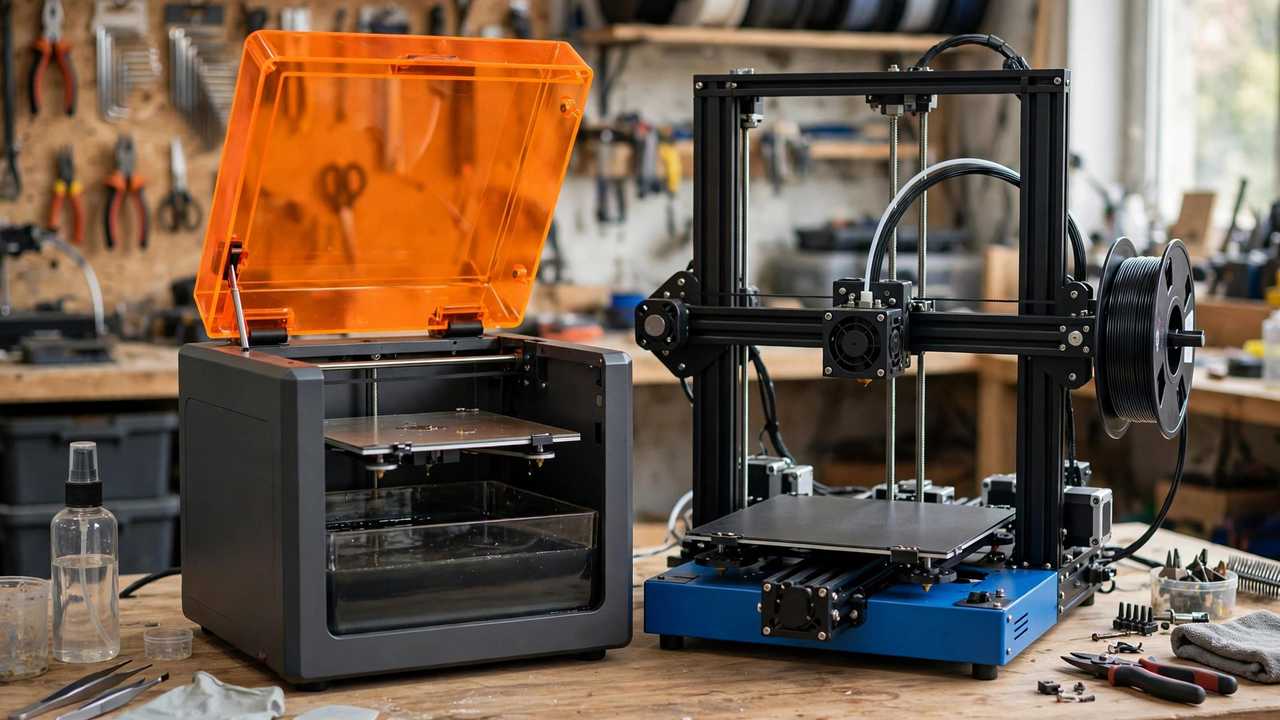
Every maker eventually faces the resin vs FDM question. You own a filament printer, you see jaw-droppingly detailed resin prints online — miniatures with visible eyelashes, jewellery with crisp filigree — and you wonder if you are missing out. Or maybe you are buying your first printer and cannot decide which technology to start with. This guide compares both honestly: the real strengths, the real annoyances, the costs nobody mentions, and how to choose based on what you actually want to make.
Short version: FDM (fused deposition modelling) melts plastic filament and draws with it, like a precise hot-glue gun. Resin printing (MSLA/SLA) cures liquid photopolymer with UV light, building parts upside-down out of a vat. They are fundamentally different processes with different strengths — and many serious makers eventually own both, using each where it shines. Understanding both, even if you only buy one, makes you a better maker.
Resin vs FDM: How Each Technology Works
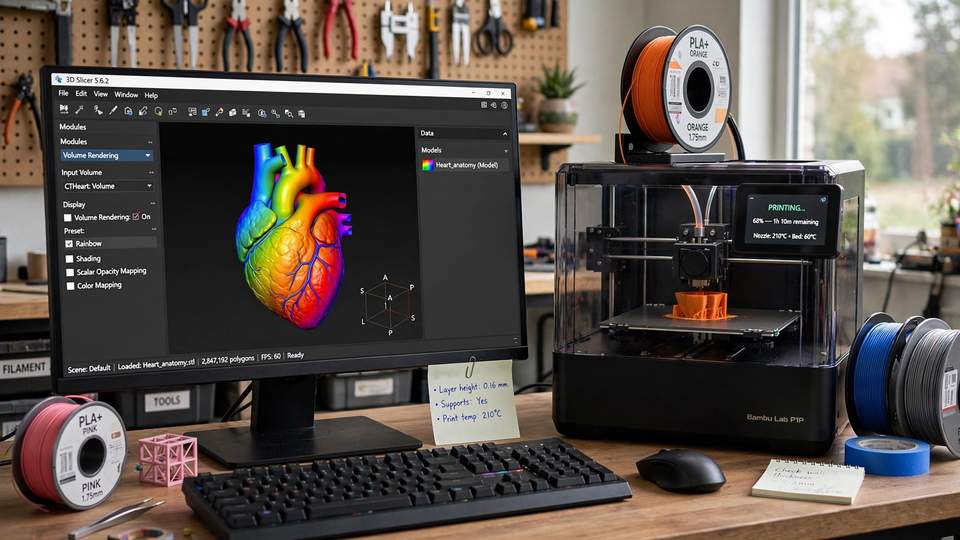
FDM feeds a spool of thermoplastic filament through a heated nozzle, depositing it layer by layer onto a build plate. Layer heights typically range from 0.12 to 0.32 mm. It is the technology behind the Ender 3, Prusa MK4, and Bambu Lab machines — the printers most hobbyists start with.
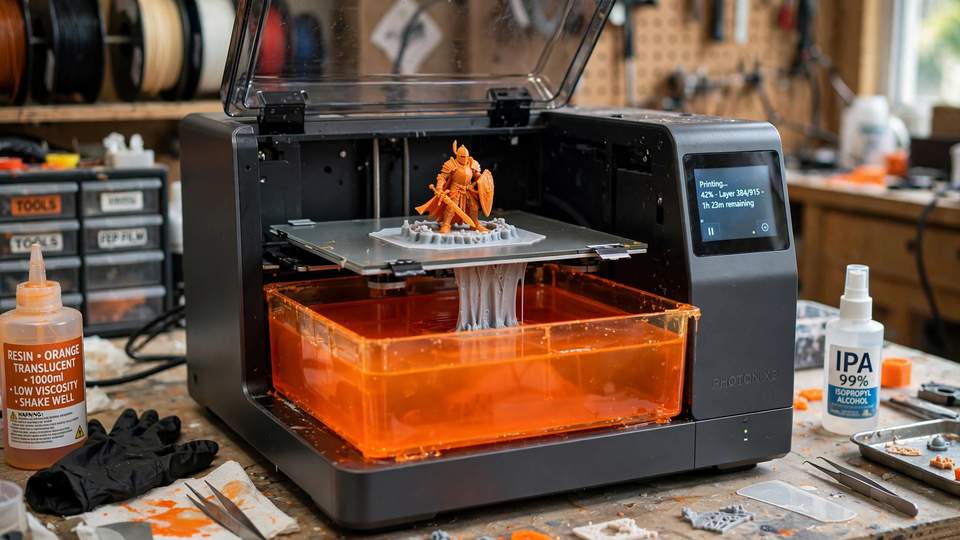
Resin (MSLA) uses an LCD screen to mask UV light, curing an entire layer of liquid resin at once in a vat. The build plate lifts after each layer, peeling the cured layer from the film at the vat’s bottom. Typical layer heights are 0.025–0.1 mm — dramatically finer than FDM. Popular machines include the Elegoo Mars and Saturn series and the Anycubic Photon line.
The key practical difference: FDM builds up from a plate in open air; resin builds down into a vat of liquid. That liquid is where most of resin’s extra hassle — and extra safety requirements — lives.
Print Quality and Detail
This is resin’s undisputed kingdom. A modern 8K resin printer resolves details around 20–30 microns — roughly ten times finer than a typical FDM print. Miniatures, dental models, jewellery masters, and scale models come off a resin printer looking injection-moulded. Layer lines are essentially invisible at normal viewing distances.
FDM has closed the gap somewhat — a well-tuned printer with a 0.2 mm nozzle and 0.08 mm layers produces surprisingly fine detail — but physics sets a hard floor. A 0.4 mm nozzle cannot draw a 0.1 mm feature. If your primary interest is miniatures, tabletop gaming figures, or detailed display pieces, resin wins by a mile and it is not close.
Where FDM claws back ground is surface finish on large, simple parts. A big functional bracket does not need 25-micron detail, and FDM produces it faster, cheaper, and stronger.
Strength and Functional Parts
FDM wins for functional strength, and the reason is material science. FDM thermoplastics (PLA, PETG, ABS, ASA, nylon) are tough engineering materials — PETG parts bend rather than shatter, nylon gears survive real mechanical loads. Standard printing resins, by contrast, are relatively brittle once fully cured. Drop a standard-resin miniature and it can chip or crack; drop a PETG part and it bounces.
Tough and engineering resins exist (ABS-like, tough, flexible formulations) and narrow the gap, but they cost more and still do not match the impact resistance of good FDM materials. For anything load-bearing — brackets, mounts, drone frames, car parts, tools — FDM is the right technology. Resin owns display and detail; FDM owns function.
Cost Comparison: The Full Picture
Printer prices have converged: decent entry machines in both technologies sit in the few-hundred-dollar-AUD range. The real cost difference is in consumables and workflow.
- Material cost: FDM filament runs roughly $25–45/kg in Australia; resin is typically $40–70/kg equivalent. Resin parts also consume supports heavily, and you cannot reclaim the resin stuck to them.
- Post-processing: FDM parts are done when the print finishes (maybe remove supports). Resin parts must be washed in isopropyl alcohol or water-washable solution, then UV-cured — requiring a wash-and-cure station ($100–200 AUD) plus ongoing IPA costs.
- Replacement parts: resin printers consume FEP films (the vat bottom, replaced every 20–50 prints), LCD screens eventually degrade, and gloves, filters, and paper towels are constant consumables.
- Failed prints: resin failures waste expensive resin and can damage the FEP film; FDM failures waste cheaper filament.
Honest accounting puts resin printing at roughly 1.5–2× the running cost of FDM for equivalent print volume. Budget accordingly.
Safety and Workspace Requirements
This is the section that decides for many people. Uncured resin is toxic — a skin sensitiser that can cause allergic reactions with repeated exposure, and the fumes need ventilation. Safe resin printing requires nitrile gloves (not latex), eye protection, good ventilation or a respirator with organic vapour cartridges, and careful handling of liquid resin and IPA wash.
None of this is unmanageable — thousands of hobbyists print resin safely — but it is a fundamentally different commitment from FDM, where PLA and PETG print with minimal odour and no special handling. If you have kids, pets, or a shared living space with no dedicated ventilated workshop area, FDM is the pragmatic choice. Resin belongs in a garage or workshop with airflow, not on the desk in your bedroom.
Disposal matters too: never pour resin or IPA wash down the drain. Cure waste resin with UV light (sunlight works) until solid, then dispose as solid waste. Your local council’s chemical waste rules apply to liquid resin.
Speed and Build Volume
MSLA resin printers cure a whole layer at once, so print time depends on height, not complexity — ten miniatures take the same time as one, provided they fit side by side. For batch production of small detailed parts, resin is remarkably efficient.
FDM speed depends on how much plastic must be extruded — bigger and denser means slower. But FDM build volumes are generally larger for the money: a 220×220×250 mm FDM printer is entry-level, while resin printers with comparable volumes cost significantly more. For large functional parts, FDM is the only practical choice at hobby budgets.
Best Uses for Each
Choose resin for: tabletop miniatures, display figures, jewellery masters, dental models, highly detailed prototypes, small-batch detailed parts.
Choose FDM for: functional brackets and mounts, enclosures, tools and jigs, cosplay armour (large parts), outdoor parts, anything load-bearing, beginners learning the hobby.
Own both when: you regularly need both detail and function — miniature hobbyists who also print terrain and storage, jewellery makers who need display stands, product designers prototyping both form and function. This is more common than beginners expect; the two technologies complement rather than replace each other. Many makers start with FDM, add a small resin printer a year later for detail work, and wonder how they ever managed with just one.
A Typical Print, Side by Side
To make the differences concrete, imagine printing a detailed 75 mm tabletop miniature on each technology. On FDM, you slice with a 0.4 mm nozzle at 0.12 mm layers, add tree supports, and press print. Three to four hours later you remove the supports (carefully — tiny FDM supports are fiddly), do minor cleanup, and you have a recognisable figure with visible layer lines on curved surfaces. Total hands-on time: maybe 20 minutes plus the print.
On resin, you hollow the model, add drain holes, orient at 45 degrees, generate light-touch supports, and slice. The print itself takes two to three hours. Then: gloves on, remove the build plate, wash the print in IPA for several minutes, remove supports (they come away cleaner than FDM), cure under UV for 5–10 minutes, and do a final inspection. Total hands-on time: 30–45 minutes, plus managing chemicals. The result looks dramatically better — but you worked harder for it and handled toxic materials throughout.
Neither workflow is “better” in isolation. The FDM path suits someone printing between other activities; the resin path suits someone who enjoys the craft of post-processing and demands the finest result. Know which person you are.
Hybrid Workflows: Using Both Together
Experienced makers with both technologies develop hybrid workflows that play to each strength. A common pattern: FDM for structure, resin for detail. Print a cosplay helmet’s base shell in FDM (large, strong, cheap), then print the intricate decorative elements — filigree, emblems, fine textures — in resin and attach them. The combination looks phenomenal and costs far less than printing everything in resin.
Another hybrid: resin masters for mould-making. Print a highly detailed master in resin, make a silicone mould from it, and cast copies in polyurethane resin. This is how small-batch producers make dozens of identical detailed parts without tying up a printer for weeks — the 3D printer makes the master once, and casting handles volume. Jewellery makers, tabletop accessory sellers, and prop makers all use this pipeline.
Moulds also solve resin’s brittleness problem elegantly: cast the final parts in tough polyurethane and you get resin-level detail with far better impact resistance than a direct resin print.
What About SLS and Other Technologies?
You will occasionally hear about SLS (selective laser sintering) — powder-based printing that needs no supports and produces superb nylon parts. It remains industrial-grade in cost (machines start in the tens of thousands), though print services make it accessible per-part. For home use in 2026, the realistic choice remains FDM vs resin. If you need a one-off SLS part, use a service bureau rather than buying a machine.
Resin vs FDM: Making the Decision
In the resin vs FDM debate, ask yourself three questions. What will you mostly print? Detail/display → resin; functional/large → FDM. Where will you print? Ventilated workshop → either; bedroom desk → FDM. What is your tolerance for process? Love meticulous workflow → resin rewards it; want to press print and walk away → FDM.
There is also a budget dimension worth stating plainly. The true startup cost of resin includes the wash-and-cure station, a litre or two of IPA, gloves, filters, spare FEP films, and a respirator if your ventilation is marginal — easily another $200–300 AUD on top of the printer. FDM’s hidden costs are smaller: a few nozzles, maybe a better build surface, and filament. If your total budget is tight, FDM gives you more printing for the money.
Finally, consider your household. Makers with young children or curious pets often find FDM’s benign materials (PLA, PETG) far easier to live with than bottles of photopolymer resin that must be kept locked away. This is not a technical point, but it is a real one — the best printer is the one you can actually run where you live.
For absolute beginners, the resin vs FDM choice is simple: FDM remains the recommended starting point — it teaches the fundamentals (slicing, calibration, materials) with the gentlest learning curve, and our calibration guide will get any FDM machine dialled in. You can always add a resin printer later when a project demands detail your FDM machine cannot deliver. For authoritative deep-dives on photopolymer technology, Formlabs publishes excellent manufacturer-neutral explainers on how SLA/MSLA processes work.
Frequently Asked Questions
Is resin 3D printing safe at home?
Yes, with proper precautions: nitrile gloves, ventilation, eye protection, and no skin contact with uncured resin. It requires more safety discipline than FDM printing.
Which is cheaper, resin or FDM?
FDM is cheaper overall — lower material costs, no wash-and-cure station needed, and cheaper replacement parts. Resin runs roughly 1.5–2× the ongoing cost.
Can resin prints be as strong as FDM prints?
Engineering resins narrow the gap, but FDM thermoplastics like PETG, ABS, and nylon remain tougher for functional, load-bearing parts. Standard resins are relatively brittle.
Should a beginner start with resin or FDM?
FDM. It has a gentler learning curve, fewer safety demands, lower running costs, and teaches transferable fundamentals. Add resin later for detail work.
Can I print large objects with a resin printer?
Large-format resin printers exist but cost far more than equivalent-volume FDM machines. For big parts at hobby budgets, FDM is the practical choice.