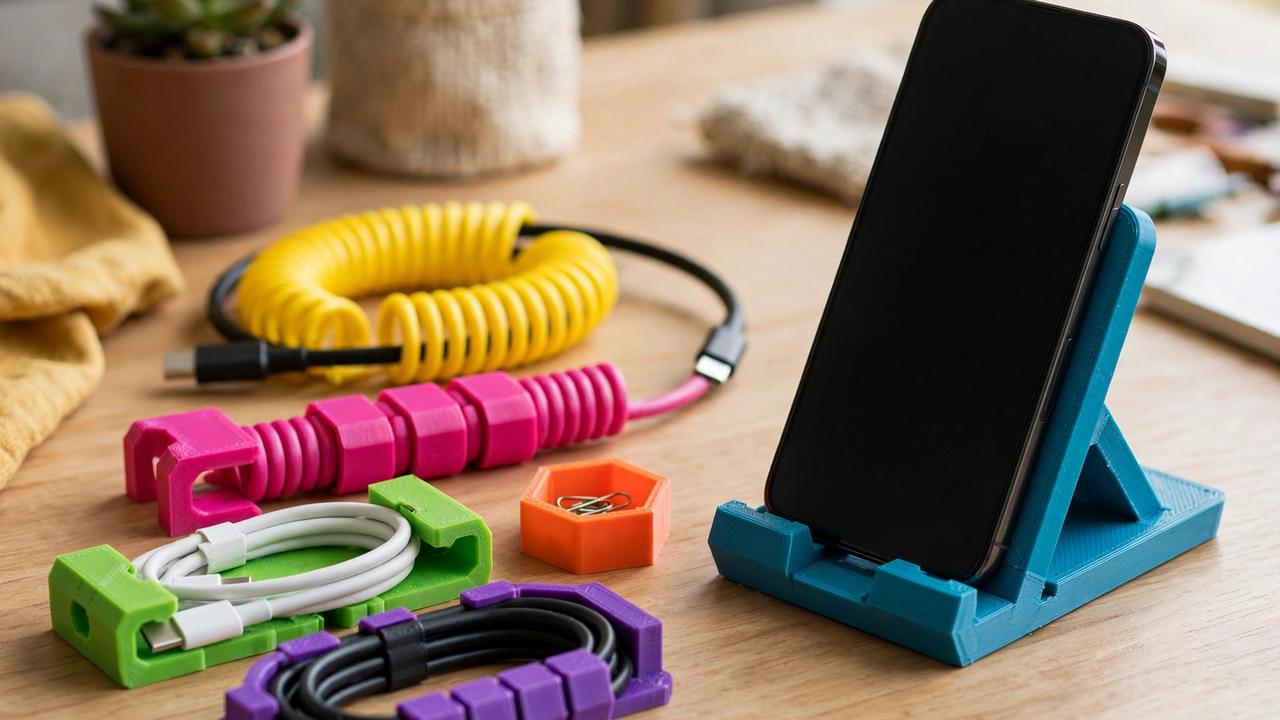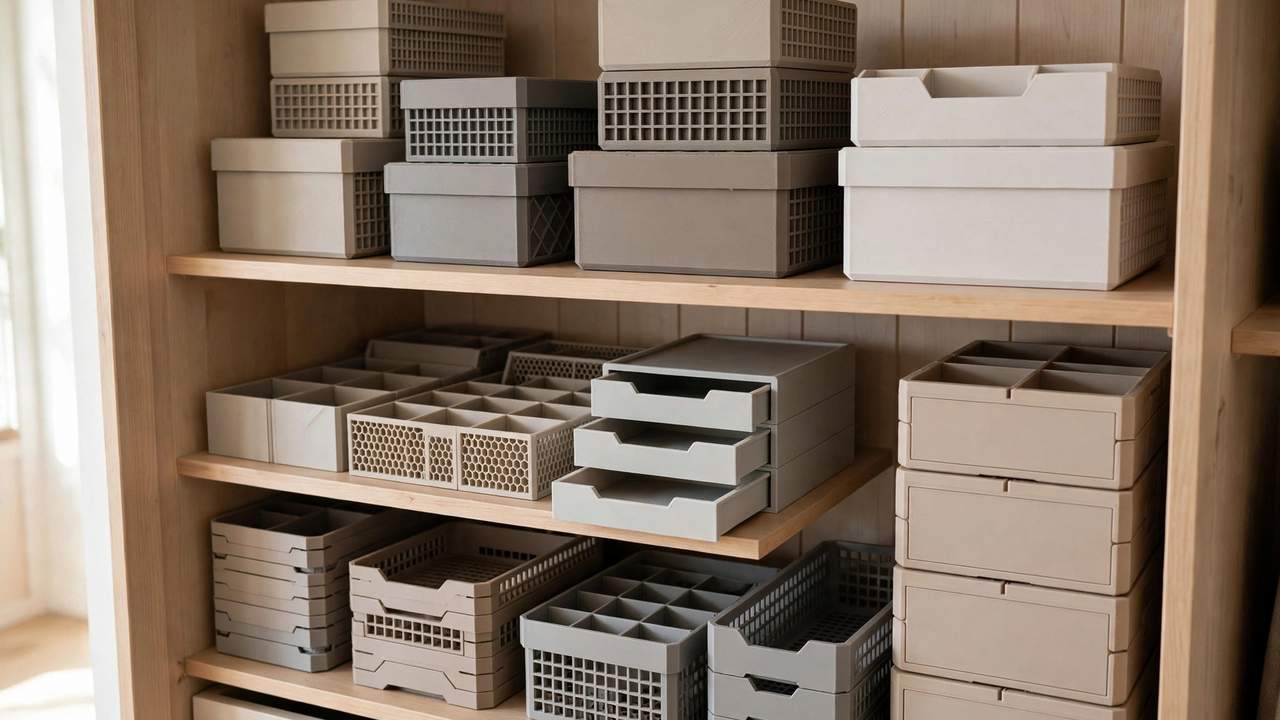
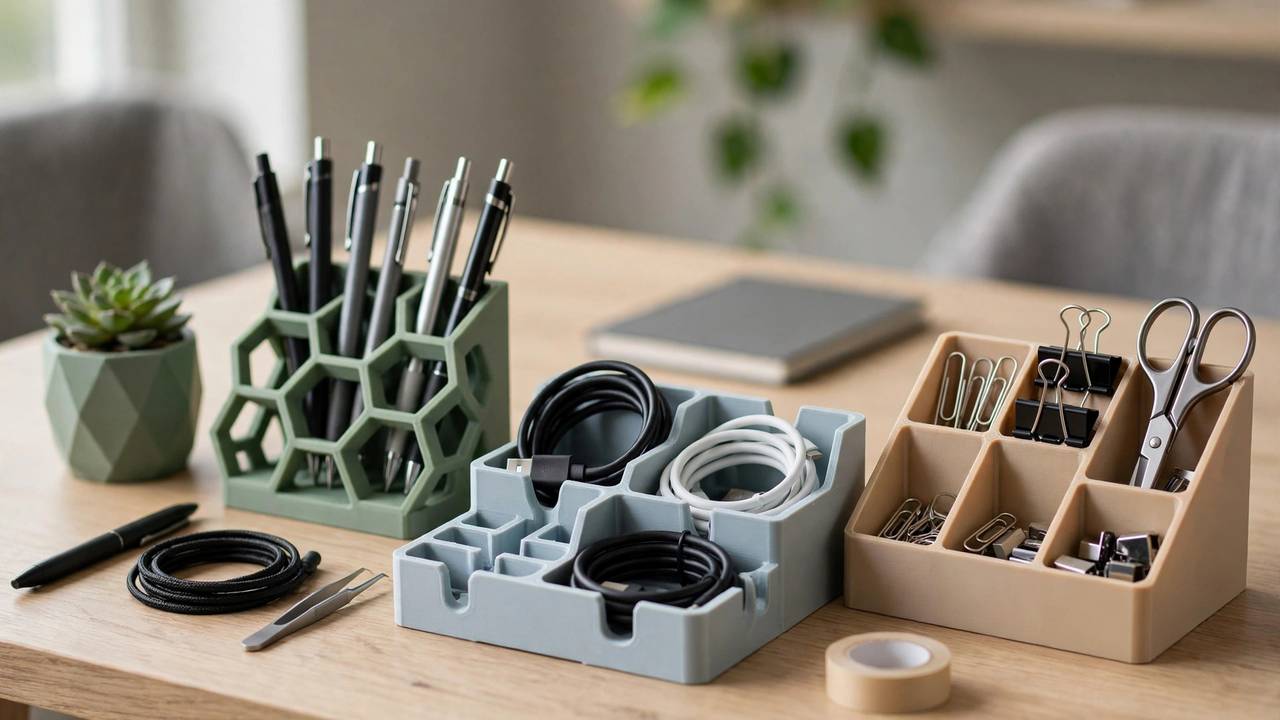
Your desk is a mess. Cables everywhere, pens rolling off the edge, that headphone stand you keep meaning to buy. Here’s the thing: you own a 3D printer, which means the best 3D printed desk organizers cost you nothing but filament and time. This roundup covers fifteen genuinely useful designs — all with free STL files — that’ll turn chaos into order.
Every design here is proven in the real world: thousands of downloads, high ratings, and prints that actually work rather than looking good in renders and failing on the build plate.
Why 3D Printed Desk Organizers Beat Store-Bought
Three reasons. First, cost: a decent desk organizer set from Kmart or Officeworks runs $30–80 AUD. The same functionality in filament costs $2–5 in PLA. That’s the real appeal of 3D printed desk organizers: custom, cheap, and genuinely useful. Second, custom fit: your desk, your drawers, your weirdly-shaped gadgets — printed organizers can be sized exactly. Third, it’s fun: there’s genuine satisfaction in using something you made.
Most of these print in PLA without supports, which makes them perfect weekend projects. PETG is worth considering for anything that takes weight or lives near a sunny window — it handles heat better than PLA.
Cable Management
1. Honeycomb Cable Holder Wall
The legendary honeycomb storage wall system. Print hexagonal tiles that lock together, then add hooks, clips, and holders wherever you need them. It’s modular, expandable, and looks fantastic. The base tiles print flat without supports; accessories vary. If you only print one thing from this list, make it this — it’s the gateway drug of desk organization.
2. Under-Desk Cable Tray
A simple tray that screws or sticks under your desk to hold power boards, chargers, and excess cable. Look for parametric versions on Printables where you punch in your power board’s dimensions and get a perfect fit. Print in PETG for strength — a loaded power board is heavier than you think.
3. Cable Clips and Guides
Small adhesive or screw-mount clips that route cables along desk edges. Print a dozen in one go — they take minutes each. The best designs have a slight flex to grip cables without crushing them. These are also brilliant for 3D printer cable management, keeping your Bowden tube and wiring tidy.
Pen, Tool, and Stationery Holders
4. Hex Pen Holder
A honeycomb-pattern pen cup that prints in vase mode (spiralize outer contour) in under two hours. Vase mode gives you a single-wall print that’s surprisingly rigid thanks to the hex geometry. Scale it up for a planter, down for a toothbrush holder — same file, endless uses.
5. Desk Drawer Gridfinity System
Gridfinity is the open-source modular drawer organization system taking over the maker world. Print base grids sized to your drawers, then bins in 1×1, 1×2, 2×2 and other unit sizes. Everything stacks, everything is labelled, and the community has designed bins for literally everything — SD cards, screws, batteries, Allen keys. Start with one drawer and you’ll end up doing every drawer in the house.
6. Stackable Parts Bins
For the workshop side of your desk: small stackable bins for screws, nozzles, and printer parts. The best designs nest when empty and stack securely when full. Print a set in different colours for instant visual sorting — red for M3 screws, blue for M4, and so on.
Tech Accessories
7. Headphone Stand
A proper headphone stand keeps your cans off the desk and prevents pad compression. The best designs have a wide, curved cradle that distributes weight — avoid the narrow-hook styles that dent headbands over time. Many include a cable groove and a small tray for a DAC or dongle. Print at 20%+ infill; headphones are heavier than they look.
8. Phone/Tablet Stand (Adjustable)
An adjustable-angle stand for video calls and recipe reading. Look for designs with a cable passthrough so you can charge while docked. The ratcheting-angle versions are more versatile than fixed-angle ones and barely use more filament.
9. Monitor/Laptop Riser with Storage
Raise your screen to eye level and reclaim the space underneath for keyboard storage or drawers. These are bigger prints — consider splitting into sections that bolt together, or print the legs and use a piece of timber for the top. A riser plus Gridfinity drawers underneath is peak desk optimization.
Desk Decor That’s Also Useful
10. Succulent Planters (Self-Watering)
Geometric planters with built-in water reservoirs. PLA works but will degrade in constant moisture over a year or two — PETG lasts much longer for anything holding soil and water. These make great gifts, too, which ties into our roundup of 3D printed gift ideas.
11. Business Card Holder
A weighted, angled card holder that actually looks professional. Print the base with 100% infill or add a cavity for coins as ballast — a light card holder that slides around the desk defeats the purpose.
12. Desk Clock (Mechanical or Digital)
From simple digital clock frames that hold a cheap clock module to fully 3D-printed mechanical gear clocks — there’s a whole sub-hobby here. The mechanical clocks are mesmerising and make fantastic conversation pieces, though they’re multi-day prints. Start with a frame for a $10 clock insert from Jaycar.
Specialty Organizers
13. SD Card and USB Drive Holder
If you’re a 3D printer owner, you have SD cards everywhere. A dedicated holder with labelled slots ends the “which card has the Benchy on it” game forever. The Gridfinity-compatible versions slot straight into your drawer system.
14. Filament Spool Holder (Desk-Mounted)
A wall or desk-edge mounted holder for your active spool, with smooth-rolling bearings. Keeps filament feeding cleanly and looks far tidier than a spool balanced on the printer’s top mount. While you’re at it, check our guide on keeping filament dry in Australia’s humidity — proper storage matters as much as the holder.
15. All-in-One Desk Caddy
The big one: a multi-compartment caddy with slots for pens, phone, headphones, sticky notes, and business cards. These are statement pieces — print in a nice silk PLA or wood-fill filament and it looks store-bought. Give it a light sand and clear coat and guests won’t believe you printed it.
Printing Tips for 3D Printed Desk Organizers
- Layer height: 0.2mm is the sweet spot — strong enough, fast enough. Drop to 0.12mm only for visible decorative pieces.
- Walls over infill: For functional organizers, 3–4 walls with 15–20% infill beats 2 walls with 50% infill. Walls carry the load.
- Material choice: PLA for looks, PETG for anything load-bearing or sun-exposed, ASA for anything near heat.
- Test fit first: For drawer inserts, print a single 1×1 Gridfinity bin first to verify your printer’s dimensional accuracy before committing to a full drawer.
- Finish matters: A quick sand with 220-grit and a coat of clear lacquer transforms a print from “hobby project” to “I bought this.”
Where to Find the Files
All of these designs live on the big three repositories: Printables (Prusa’s site, excellent search and reward system), Thingiverse (the old giant, variable quality), and MakerWorld (Bambu’s ecosystem, great for Bambu owners). Search the names above and sort by downloads or likes — the community has already done the quality control for you.
More Ideas: 16–20
16. Filament Spool Drawer Dividers
If you store filament in drawers or tubs, printed dividers keep spools upright and separated. Simple T-shaped dividers that friction-fit — measure your drawer once, print a set. Combine with silica gel tubs for a proper dry-storage drawer.
17. Whiteboard/Easel Phone Holder
A gooseneck-style holder is hard to print reliably, but rigid arm stands with ball joints (printed threads!) work brilliantly for positioning a phone as a second monitor or print camera. Print the joints in PETG for durability.
18. Coaster Set with Holder
Hex coasters with a cork or felt base glued in — the classic “my first useful print.” The holder keeps six coasters tidy. Use PETG or ASA if they’ll hold hot mugs; PLA softens under a fresh cuppa.
19. Wall-Mounted Tool Holders
French cleat systems or simple pegboard hooks for the wall above your desk. Hold scissors, rulers, USB drives, and that caliper you can never find. The cleat system means you can rearrange endlessly without new holes.
20. Print-in-Place Articulated Desk Toy
Not an organizer, but every desk needs one: print-in-place articulated dragons, slugs, or flexi dinosaurs. They print as a single piece with working joints — no assembly. They’re the perfect calibration test (if the joints fuse, your extrusion multiplier is off) and the perfect fidget toy for thinking.
Print Settings Deep Dive for Functional Organizers
Getting organizers right is about settings as much as design:
- First layer: This is the visible bottom of most organizers. A textured PEI sheet gives a professional matte finish; a smooth sheet gives a glossy look. Glue stick on smooth PEI prevents the dreaded “too good” adhesion that chips the sheet.
- Seams: Set seam position to “rear” or paint it manually in the slicer. A random seam on a visible organizer looks messy; an aligned rear seam disappears.
- Ironing: Enable ironing on top surfaces for coasters, trays, and flat organizers. It melts the top layer smooth — the difference between “printed” and “manufactured” looks.
- Adaptive layer height: Use 0.28mm for straight walls and 0.12mm only where curves need it. Modern slicers do this automatically and it halves print time on decorative pieces.
Filament Cost Reality Check (Australia)
Let’s put real numbers on the “printing beats buying” claim with Australian pricing. Even the most ambitious 3D printed desk organizers cost a fraction of store-bought equivalents:
- 1kg PLA: $25–35 AUD (eSUN, Creality, local brands via 3D Printer Superstore or Amazon AU)
- 1kg PETG: $28–40 AUD
- Small organizer (cable clips ×12): ~30g = under $1
- Medium organizer (pen holder, headphone stand): 80–150g = $3–5
- Gridfinity drawer system (full drawer): 400–600g = $12–20
- Equivalent bought organizers: $15 for clips, $25–40 for a headphone stand, $50–80 for drawer systems
The savings are real but don’t ignore time: a full drawer system is 20–30 hours of printing. If your time is worth $50/hour, buying wins. But nobody in this hobby counts their time — the printing is the fun. And for custom-fit pieces that don’t exist commercially, there’s no bought alternative at any price.
Reader Showcase: What Makers Are Printing
The desk organizer community is remarkably generous with remixes. Before designing from scratch, search Printables for remixes of the popular designs — you’ll find Gridfinity bins for every obscure tool, honeycomb accessories for specific gadgets, and cable management adapted for standing desks, corner desks, and tiny apartment nooks. The remix culture means someone has usually already solved your exact problem.
If you create a useful remix, upload it. The community runs on reciprocity, and a well-documented remix with print settings often outperforms the original in downloads. Include photos of the printed result (not just renders), note your printer and settings, and specify the exact use case. Future you will thank present you when you need to reprint it in two years.
Frequently Asked Questions
What filament is best for desk organizers?
PLA is fine for most desk organizers — it’s easy to print and looks great. Use PETG for anything load-bearing, sun-exposed, or holding moisture (like planters). ASA is overkill for indoor desk use.
How much filament does a desk organizer use?
Small items like cable clips use 10–20g (under $1 of PLA). Medium organizers like pen holders use 50–100g. Large systems like a full Gridfinity drawer setup can use 500g–1kg. At typical PLA prices, even the big projects cost under $30.
Do I need supports for desk organizers?
Most well-designed organizers print support-free — designers know their audience. Check the designer’s print settings and photos before starting; if the photos show clean overhangs, you’re fine.
What is Gridfinity?
Gridfinity is an open-source modular organization system: base grids in standard unit sizes plus bins, holders, and accessories that all interlock. It’s become the standard for 3D printed drawer organization.
Can I sell 3D printed desk organizers?
Check the license on each design — many are non-commercial. If you want to sell, look for CC-BY or public domain designs, or design your own. Our guide to pricing 3D printed products in Australia covers the business side.