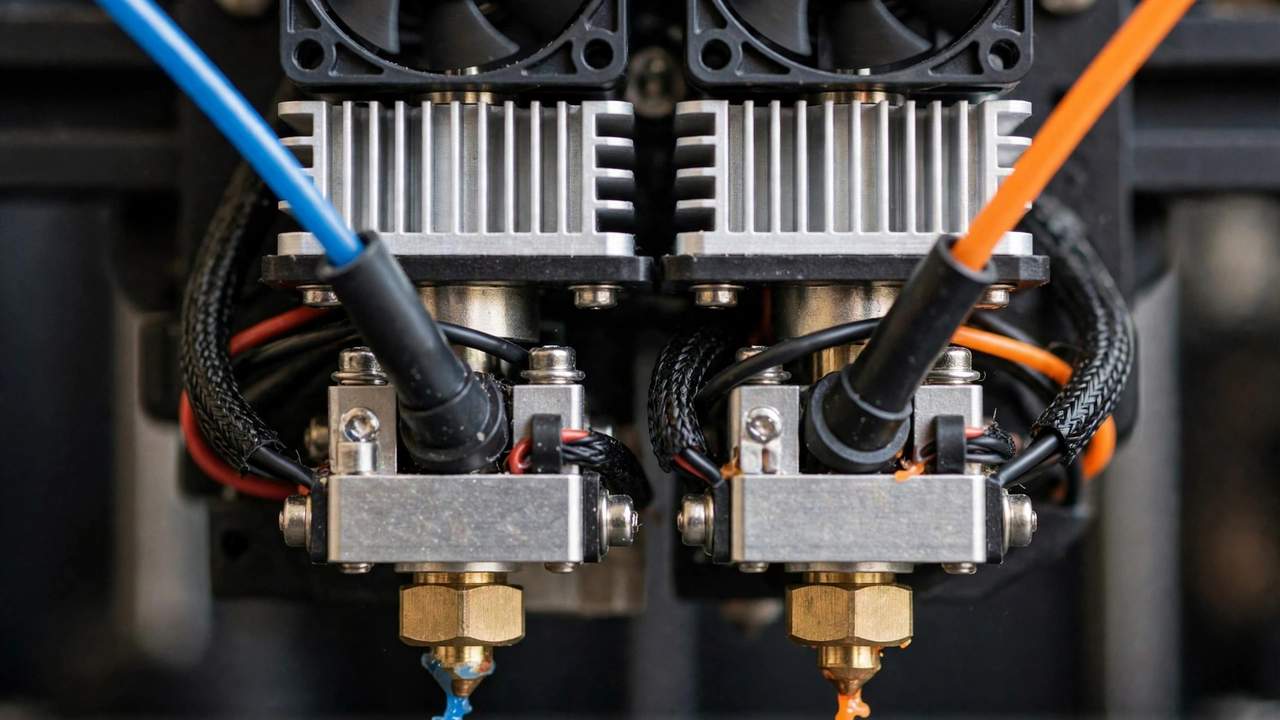
There comes a point in every maker’s life when one nozzle isn’t enough. Maybe you want dissolvable supports for impossible overhangs, two colours that don’t bleed into each other, or a rigid part with a flexible hinge printed in one go. Whatever the reason, choosing the best dual extruder 3D printer in 2026 is trickier than it sounds — because “dual extrusion” now covers four genuinely different technologies, and they don’t all suit the same jobs. This guide breaks down the approaches honestly, then compares four machines you can actually buy in Australia right now, with real Aussie prices.
What “dual extruder” actually means in 2026
A decade ago, “dual extruder” meant two nozzles bolted to one carriage. Today it covers any printer that puts down two different materials in a single job — and the engineering has split into camps with very different trade-offs. The approach determines your purge waste, calibration pain, and which material combinations are possible, so it matters more than the spec sheet.
The 2026 landscape:
- Dual-nozzle, single carriage — two hotends on one toolhead. Simple and fast, but the idle nozzle can ooze and the extra weight limits speed.
- IDEX (independent dual extruders) — two independent toolheads; the idle head parks out of the way, so no ooze, plus duplicate/mirror print modes. Fiddlier calibration, and getting harder to find new in Australia.
- Toolchanger — one carriage picks up and docks entire toolheads. Near-zero waste, expandable to five materials — but complex and expensive.
- Hotend-swapping — the printer swaps whole hotends in seconds. Most of the toolchanger’s waste savings with less mechanical complexity.
A quick note on single-nozzle “multicolour” systems (filament changers like the Bambu AMS on a single-nozzle machine): brilliant for colours, but they purge a waste tower on every change and can’t mix truly different materials. For those, see our multicolour printer roundup — this guide is about machines with genuinely separate extrusion paths.
The three classic approaches, honestly compared
Dual-nozzle: simple and fast, but watch the ooze
Two hotends, one carriage — the oldest approach and still the most common. Tool changes are instant, the mechanics are simple, and it’s the cheapest route to two materials. The downsides are well known: the idle nozzle sits at temperature and dribbles plastic onto your print (hence ooze shields and prime towers), and getting both nozzle tips at exactly the same height is a calibration step that can ruin prints when it’s off. For two-colour decorative prints and same-temperature material pairs, it’s perfectly capable.
IDEX: the clever one that’s fading from shelves
Independent dual extrusion puts each hotend on its own carriage, so the idle head parks at the side — no ooze, no cross-contamination. The party tricks are genuinely useful: duplicate mode prints two copies at once, mirror mode prints a part and its mirror image. The catch is calibration complexity and availability — the classic budget IDEX machines are largely discontinued, and in 2026 there isn’t a standout IDEX printer with solid Australian retail distribution. A good used one is a lovely find; as a new purchase in Australia, the market has moved on.
Toolchangers and hotend-swappers: the waste-free future
A toolchanger docks each toolhead when idle — no ooze, no purge tower, and each tool can even carry a different nozzle size. Most capable, most expensive, most moving parts. Hotend-swapping (pioneered at scale by Bambu Lab’s H2C) keeps most of the benefit — the whole hotend lifts out and a clean one drops in within seconds — with a simpler mechanism. If purge towers eating half a spool is your main frustration with multicolour printing, these are the machines that fix it.
The best dual extruder 3D printers you can actually buy in Australia
Every printer below is currently available from Australian retailers with AUD pricing confirmed in October 2026 — no discontinued models, no grey imports.
Bambu Lab H2D — the best dual extruder 3D printer for most makers
The H2D is the machine that dragged dual extrusion into the modern era. Its dual-nozzle architecture puts two high-flow hotends (350 °C max) on a single toolhead, and closed-loop servo extrusion plus AI process monitoring engineer away the classic dual-nozzle headaches — ooze, misalignment, failed tool changes. The 350 × 320 × 325 mm build volume is generous, the 65 °C actively heated chamber tames ABS, ASA, polycarbonate and carbon-fibre composites, and the whole thing is enclosed with air filtration.
What sets it apart is how little you think about it: automatic bed levelling, vibration compensation, and filament handling that just works. Pair it with the AMS 2 Pro and each nozzle gets its own 4-material feed. It’s the closest thing to an appliance that dual extrusion has ever had.
- Approach: dual-nozzle, single toolhead
- Build volume: 350 × 320 × 325 mm
- Chamber/nozzle: 65 °C actively heated chamber, 350 °C hotends
- Australian price: from $2,499 AUD (machine only) at Core Electronics and CDSoft; $2,799 AUD with AMS 2 Pro combo at Core Electronics
- Best for: makers who want dual-material printing without the tinkering — dissolvable supports, two-colour parts, and engineering materials in one reliable box
Original Prusa XL (2-toolhead) — the toolchanger for people who hate waste
The Prusa XL takes the opposite philosophy to Bambu: instead of refining dual nozzles, it docks entire toolheads. The 2-toolhead version gives you genuine two-material printing with essentially zero purge waste — the idle tool parks in its dock while the active one works — and it can grow to five toolheads later if your ambitions (or business) do.
The rest is pure Prusa: a huge 360 × 360 × 360 mm build volume, a segmented 16-zone heatbed that only heats the area in use, open-source firmware and hardware, and management through Prusa Connect. It’s a bigger, more hands-on machine than the H2D — but for small-batch production and serious multi-material work, the toolchanger remains the gold standard.
- Approach: toolchanger (2 toolheads, expandable to 5)
- Build volume: 360 × 360 × 360 mm
- Notable: segmented 16-zone heatbed, open-source throughout, Prusa Connect remote management
- Australian price: from $4,999.99 AUD (2-tool semi-assembled) at Rising Sun FPV; fully assembled versions from around $5,899.95 AUD at Aurarum
- Best for: production-minded makers and small businesses where purge waste costs real money and five-material jobs are on the horizon
Bambu Lab H2C — hotend-swapping with almost no waste
The H2C is Bambu’s answer to the purge-tower problem. Its Vortek hotend-change system physically swaps the entire hotend in seconds — cut, swap, heat, resume — cutting material waste by up to 95% compared with single-nozzle filament changing. Each hotend stores its filament info in onboard memory so the printer always matches the right material to the right hotend.
Underneath, it’s the same engineering-filament monster as the H2D: 65 °C actively heated chamber, 350 °C all-metal hotends, and tool changes accurate to micrometres. The trade-off versus the H2D is that it can’t truly print two materials simultaneously the way a dual-nozzle or IDEX can — it swaps fast, but it swaps. For sequential multi-material parts, that’s a distinction without a difference.
- Approach: hotend-swapping multi-material system
- Build volume: large format (H-series platform)
- Chamber/nozzle: 65 °C actively heated chamber, 350 °C hotends, flame-retardant chamber construction
- Australian price: $3,399 AUD (AMS Combo) at Core Electronics; $3,699 AUD at Phaser FPV — expect a 21–40 day lead time at some retailers
- Best for: multi-colour and multi-material prints where waste bothers you — big colour-change models without the purge tower guilt
Flashforge Guider 3 Ultra — the tall-format dual-extrusion workhorse
If your parts are tall, the Guider 3 Ultra deserves a look: its 330 × 330 × 600 mm build volume is the tallest here by a wide margin. The dual extruders handle soluble or same-material supports, the CoreXY frame stays rigid at up to 500 mm/s, and high-temperature extruders (rated to 320 °C) cover the engineering filament range.
It’s a more industrial proposition than the Bambu machines — 70+ kg of printer, HEPA 13 air filtration, a built-in filament drying chamber, and a camera for remote monitoring. The honest caveats: the chamber is enclosed but not actively heated, so full-volume prints in warp-hungry materials need care, and dual-extrusion calibration rewards patience. Check the manufacturer’s product page for full specifications and local support details.
- Approach: dual extruders, single carriage
- Build volume: 330 × 330 × 600 mm
- Notable: CoreXY, 500 mm/s max speed, HEPA 13 filtration, filament drying chamber, auto-shutdown
- Australian price: $4,999 AUD at Flashforge’s Australian store; also stocked by Australian resellers including CDSoft
- Best for: tall functional parts, jigs and fixtures, and workshops that need dual extrusion at production scale
Side-by-side comparison
| Printer | Approach | Build volume | AU price (from) | Standout strength |
|---|---|---|---|---|
| Bambu Lab H2D | Dual-nozzle | 350 × 320 × 325 mm | $2,499 | Easiest dual-material printing; heated chamber |
| Bambu Lab H2C | Hotend-swapping | Large format | $3,399 | Up to 95% less purge waste |
| Prusa XL (2-tool) | Toolchanger | 360 × 360 × 360 mm | $4,999.99 | Zero-waste multi-material; expandable to 5 tools |
| Flashforge Guider 3 Ultra | Dual extruder | 330 × 330 × 600 mm | $4,999 | Tallest build volume; industrial build |
Prices confirmed from Australian retailers in October 2026 and include GST where shown; expect some variation between stores and occasional lead times on newer models.
Best Dual Extruder 3D Printer: Which One Should You Buy?
Get the Bambu Lab H2D if you want the best dual extruder 3D printer for general making — dual nozzles without the traditional pain, a heated chamber for engineering materials, and software that stays out of your way. For dissolvable supports, two-colour prints, and PLA-plus-TPU flexible hinges, it’s the easy recommendation.
Get the Bambu Lab H2C if purge waste keeps you up at night. Anyone printing large multi-colour models on a single-nozzle-plus-AMS setup knows the pain of a purge tower that outweighs the part. The H2C’s hotend swapping fixes that while keeping Bambu’s reliability.
Get the Prusa XL if you’re running — or planning — a small production operation. The toolchanger’s zero-waste multi-material printing, huge cubic volume, and open-source repairability make it the long-term workhorse. Tinkerers who enjoy building and modifying their machines will feel at home; if you’d rather unbox and print, look at the Bambu options instead.
Get the Flashforge Guider 3 Ultra if your parts are tall or your use is commercial. Nothing else here touches 600 mm of Z height, and the industrial build suits a workshop running prints all day.
One last piece of advice whatever you choose: dual extrusion rewards good calibration more than any other kind of printing. Budget an afternoon for nozzle alignment, temperature towers for each material, and slicer tuning before judging the machine.
Frequently Asked Questions
What is the best dual extruder 3D printer in 2026?
For most makers, the Bambu Lab H2D (from $2,499 AUD) is the best dual extruder 3D printer in 2026 — genuine dual-nozzle printing with a heated chamber and minimal fuss. Waste-conscious printers should look at the Bambu Lab H2C’s hotend-swapping system, while production users will get the most from the Prusa XL toolchanger.
What is the difference between IDEX and dual-nozzle printers?
Dual-nozzle printers mount two hotends on one carriage — simple and fast, but the idle nozzle can ooze. IDEX (independent dual extrusion) gives each hotend its own carriage so the idle head parks out of the way, eliminating ooze and enabling duplicate and mirror printing modes. IDEX machines are increasingly hard to buy new in Australia in 2026.
Do dual extruder printers waste a lot of filament?
It depends on the approach. Dual-nozzle and IDEX printers typically use small prime towers or ooze shields — modest waste. Single-nozzle filament changers waste far more through purging. Toolchangers (Prusa XL) and hotend-swappers (Bambu Lab H2C) produce the least waste of all, with the H2C cutting purge waste by up to 95%.
Can a dual extruder printer print two materials at the same time?
True simultaneous extrusion — both nozzles laying plastic at once — is an IDEX feature (duplicate/mirror modes). Dual-nozzle printers like the H2D and hotend-swappers like the H2C alternate between materials within a single print rather than extruding both at literally the same instant, which covers nearly all real-world multi-material jobs.
Is the Prusa XL worth it over the Bambu Lab H2D?
It depends on your use. The Prusa XL costs roughly twice as much (from $4,999.99 AUD vs $2,499 AUD) but offers zero-waste toolchanging, a larger cubic build volume, expandability to five toolheads, and fully open-source hardware. For production work it earns its keep; for hobby multi-material printing, the H2D does the job for less.
Can I print dissolvable supports on these printers?
Yes — that’s one of the main reasons to buy a dual extrusion machine. Run your model material (PLA, PETG, ABS) through one extruder and a soluble support material like PVA (for PLA) or HIPS (for ABS, dissolved in limonene) through the other. All four printers in this guide support soluble-support workflows with the right slicer settings.