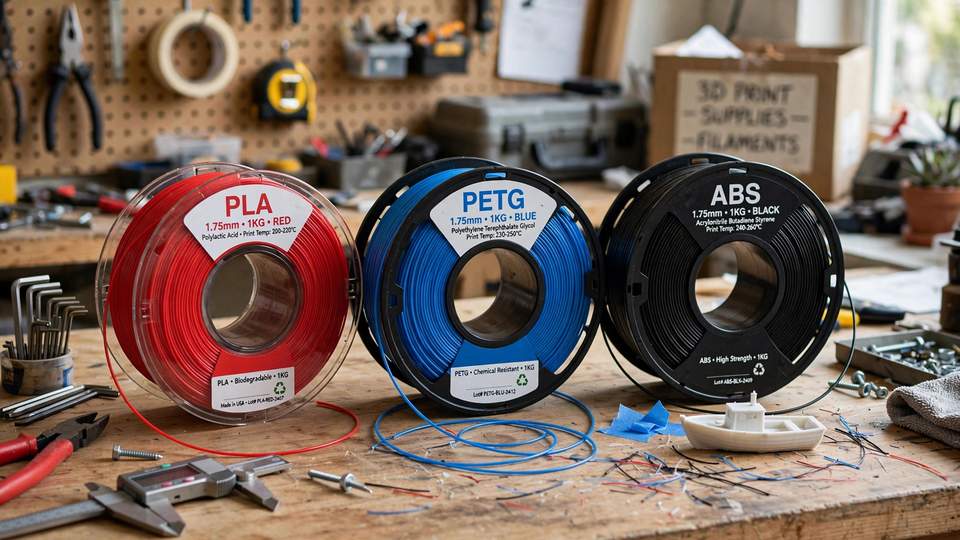
Ask any Australian maker what they print with and you’ll hear the same three names: PLA, PETG, and ABS. But the pla vs petg vs abs debate looks different here than it does in the northern hemisphere. A material that behaves beautifully in a temperature-controlled European workshop can turn into a stringy, warping mess in a Brisbane garage in February. Heat, humidity, and UV hit each filament differently — and picking the wrong one for your climate is the most common reason beginners blame their printer for problems that are actually the filament’s fault.
This guide breaks down the real differences between the three, how each one handles an Australian summer and a damp winter, what print settings actually work, how to store filament so it doesn’t go off, and which brands are worth your money locally.
PLA vs PETG vs ABS at a Glance
Here’s the short version for anyone in a hurry. The table below covers the things that actually matter when you’re choosing a spool:
| Property | PLA | PETG | ABS |
|---|---|---|---|
| Nozzle temp | 190–220 °C | 230–250 °C | 230–250 °C |
| Bed temp | 50–60 °C (or cold) | 70–80 °C | 90–110 °C |
| Enclosure needed | No | No (helps) | Strongly recommended |
| Ease of printing | Easiest | Moderate | Tricky |
| Strength | Stiff but brittle | Strong and tough | Strong, impact resistant |
| Heat resistance | Softens ~60 °C | Softens ~80 °C | Softens ~100 °C |
| Humidity sensitivity | Low | Moderate–high | Moderate |
| Typical AU price (1 kg) | $25–$40 | $28–$45 | $30–$50 |
| Best for | Models, prototypes, display pieces | Functional parts, outdoor use | Car parts, enclosures, heat exposure |
Prices are AUD per kilo for decent-quality filament from Australian suppliers in late 2026 — budget options exist from around $19/kg, and premium brands run higher. Treat these as a guide and check the current price before you buy.
PLA: The Easy Starter (With One Big Australian Catch)
PLA (polylactic acid) is where almost everyone starts, and for good reason. It prints at low temperatures (190–220 °C nozzle, 50–60 °C bed, or even a cold bed), barely warps, doesn’t need an enclosure, and smells faintly sweet rather than like a chemical factory. It’s also the cheapest of the three and comes in the wildest range of colours and finishes. If you’re printing desk toys, board game pieces, organisers, or display models, PLA is all you’ll ever need.
Here’s the catch, and it’s a big one in Australia: PLA’s glass transition temperature — the point where it starts going soft — is only around 60 °C. That sounds high until you consider that the inside of a parked car in an Australian summer easily hits 70–80 °C. A PLA phone mount on a Perth dashboard in January will slowly sag into modern art. Anything that lives outdoors or in a hot car needs something tougher.
PLA is also more brittle than people expect. It prints beautifully, but a thin PLA bracket can snap where PETG would flex. For decorative and low-stress parts that’s fine. For anything structural, read on.
Print it at: nozzle 200–215 °C (start at 205 °C and adjust), bed 50–60 °C. PLA is forgiving — if your first layer sticks and your temps are in the ballpark, you’ll get a good print.
PETG: The Australian Sweet Spot
PETG (the glycol-modified version of the plastic in drink bottles) is the material most Australian makers end up settling on for functional prints. It’s significantly tougher than PLA — parts flex instead of snapping — and it handles heat up to around 80 °C, which is enough for most real-world use short of a dashboard in summer. It’s also reasonably chemical resistant and prints without an enclosure, which makes it the natural step up from PLA.
The trade-off is that PETG is fussier to print. It loves to string — those fine wisps of plastic between parts of a print — and it can stick too well to some build plates. Both problems are solvable: dial in retraction in your slicer, run the first layer a touch further from the bed than with PLA, and consider a thin layer of glue stick as a release agent on PEI plates. Once you’ve got a profile dialled in, PETG prints reliably.
The other thing to know: PETG is hygroscopic, meaning it actively absorbs moisture from the air. In humid parts of Australia — Brisbane, Sydney, Darwin in the wet season — an open spool of PETG can go from printing beautifully to stringing like a spiderweb in a week or two. Storage matters more for PETG than for the other two, which we’ll cover properly below.
Print it at: nozzle 235–245 °C, bed 75–85 °C. Slow the first layer down and give it a bit more nozzle-to-bed gap than PLA.
ABS: Strong, Hot, and Demanding
ABS is the plastic your LEGO bricks are made from — tough, impact resistant, and able to handle temperatures up to around 100 °C. Car interior parts, drone frames, tool holders, anything that needs to survive heat and knocks: ABS is the right material. It’s also the only one of the three that can be smoothed with acetone vapour for a glossy finish, which is why cosplay and prop builders love it.
The catch is that ABS is the hardest of the three to print well. It shrinks as it cools, which causes warping and layer splitting unless the print environment stays warm — that’s why an enclosure is strongly recommended. A draft from an open window can ruin a large ABS print. It also smells noticeably worse than PLA or PETG while printing, so ventilation matters and most experienced makers won’t run it in a bedroom.
For Australian beginners, the honest advice is: don’t start with ABS. Get comfortable with PLA, graduate to PETG, and only reach for ABS when you have a specific part that needs it — and ideally an enclosure or an enclosed printer. If you’re choosing a printer partly for ABS work, see our guide to the best 3D printers under $500 in Australia, where we note which machines handle higher-temp materials.
Print it at: nozzle 240–250 °C, bed 95–105 °C, in an enclosure if at all possible. A brim or raft helps with bed adhesion on large parts.
How Australia’s Climate Treats Each Filament
This is the section that generic overseas guides skip, and it’s the one that matters most for us. Three climate factors shape the PLA vs PETG vs ABS decision in Australia:
Heat
Summer temperatures above 40 °C are normal across much of the country, and enclosed spaces get far hotter. A PLA part left in a car, a shed, or a north-facing room can soften and deform at temperatures that feel completely normal for an Australian afternoon. PETG survives most of this (its softening point is around 80 °C), and ABS handles all of it. Practical rule: if the part will ever sit in a hot car or in direct sun, don’t use PLA.
Humidity
Coastal and tropical Australia is humid for much of the year, and moisture is filament’s quiet enemy. Wet filament prints with popping, crackling, rough surfaces, and weak layer adhesion — symptoms beginners almost always blame on the printer. PETG is the worst offender of the three for absorbing moisture; PLA is the most tolerant. If you live somewhere humid, budget for proper storage (below) from day one rather than learning this the expensive way.
UV exposure
Australian UV levels are brutal, and all three filaments degrade in direct sunlight over time — PLA goes brittle fastest. For outdoor parts, PETG is the minimum sensible choice, and ASA (ABS’s weather-resistant cousin) is better still. Paint or UV-resistant coatings extend the life of any outdoor print significantly.
Storing Filament in Humid Australia
How you store filament matters more here than in most countries. A spool left open on a shelf in Brisbane will absorb enough moisture within weeks to noticeably degrade print quality. The fix is simple and cheap:
- Vacuum bags with desiccant: the cheapest effective option. Squeeze the air out, toss in a few silica gel sachets, and spools stay dry for months. Reusable vacuum bags made for filament cost a few dollars each.
- Dry boxes: a sealed plastic tub with a big bag of desiccant or a rechargeable dehumidifier pack. Many makers print from the dry box directly by feeding filament through a small hole, which keeps the spool dry during long prints too.
- Filament dryers: dedicated dryers from brands like Sunlu typically run $70–$120 AUD and actively drive moisture out of a spool over a few hours. Worth it if you print a lot of PETG or nylon. Check the current price — they’ve been getting cheaper.
- Watch the desiccant: silica gel sachets saturate and stop working. The colour-changing type tells you when it’s spent, and you can recharge it in an oven or a filament dryer.
You can also dry a wet spool in a regular oven at 50–60 °C for a few hours, but watch it like a hawk — ovens overshoot, and a melted spool is a miserable discovery. A purpose-built dryer is safer and not much more expensive than the filament you’d otherwise waste.
Best Filament Brands You Can Buy in Australia
You don’t need exotic imported filament. These brands are readily available locally and consistently print well:
- eSun: the workhorse brand — widely stocked across Australia, consistent quality, and very reasonable prices (their PLA+ typically runs $25–$35/kg locally). If you only ever buy one brand, make it this one.
- Polymaker (PolyLite / PolyTerra): a step up in consistency and packaging — every spool arrives vacuum-sealed with desiccant, which matters in our climate. PolyLite PLA typically runs $35–$45/kg in Australia.
- 3D Fillies: Australian-made filament from Melbourne with a loyal local following. Buying local means fresher stock and faster shipping, and their PLA prints beautifully.
- Anycubic / Elegoo / Creality filament: the printer brands’ own filament lines are generally decent, often discounted in bundles with printers, and tuned for their own machines’ stock profiles.
Whatever brand you choose, buy from an Australian supplier rather than the cheapest overseas listing. Filament is heavy, slow to ship internationally, and you want stock that hasn’t spent two months in a humid shipping container. Local shops like Core Electronics, 3D Printer Superstore, and the manufacturer AU stores all carry the brands above. For more on picking a printer to go with your filament, our best PETG filament in Australia roundup covers specific spools worth buying.
PLA vs PETG vs ABS: Our Final Recommendation
Here’s the decision in plain terms:
- Just starting out? Buy PLA. It’s cheap, forgiving, and you’ll learn the fundamentals without fighting the material. Keep finished parts out of hot cars.
- Printing functional parts? Move to PETG. Brackets, mounts, tool holders, anything that takes stress — PETG is tougher and handles Australian heat far better. Just store it properly.
- Need maximum heat resistance? That’s ABS (or ASA for outdoor use). Only once you’re comfortable with the first two, and ideally with an enclosure.
Most experienced Australian makers keep all three on the shelf and reach for whichever suits the job — PLA for quick prototypes and display pieces, PETG for the functional workhorse prints, ABS for the hot and hard stuff. There’s no single winner in the PLA vs PETG vs ABS debate; there’s just the right material for the part in front of you. For the authoritative technical breakdown of material properties, Polymaker’s material guides are a solid reference alongside this article.
Frequently Asked Questions
Can I leave PLA prints in my car in Australia?
No — not in summer. PLA starts softening around 60 °C, and a parked car in an Australian summer easily reaches 70–80 °C inside. Dashboard mounts, phone holders, and any part that lives in a car should be printed in PETG at minimum, or ABS/ASA for the hottest spots.
Why does my PETG print fine in winter but string badly in summer?
Humidity. PETG absorbs moisture from the air, and humid summer air loads a spool up fast. Wet PETG strings, pops, and prints with rough surfaces. Dry the spool in a filament dryer for 4–6 hours and store it in a sealed dry box with desiccant — the difference is night and day.
Is ABS safe to print at home?
With sensible precautions, yes. ABS releases more fumes and odour than PLA or PETG, so print in a ventilated room or an enclosure with extraction — and not in a bedroom. An enclosure also dramatically improves print quality by preventing warping.
Which filament is cheapest in Australia?
PLA, by a comfortable margin. Decent PLA runs $25–$40/kg from Australian suppliers, with budget options from around $19/kg. PETG typically costs a few dollars more per kilo, and ABS/ASA sit at the top of the three. For most hobbyists the difference is small compared to the cost of failed prints from using the wrong material.
Do I need different nozzles for PLA, PETG, and ABS?
No. All three print fine on the standard brass 0.4 mm nozzle that comes with virtually every printer. Hardened steel nozzles are only needed for abrasive materials like carbon-fibre or glow-in-the-dark filaments. Purge the old material thoroughly when switching.