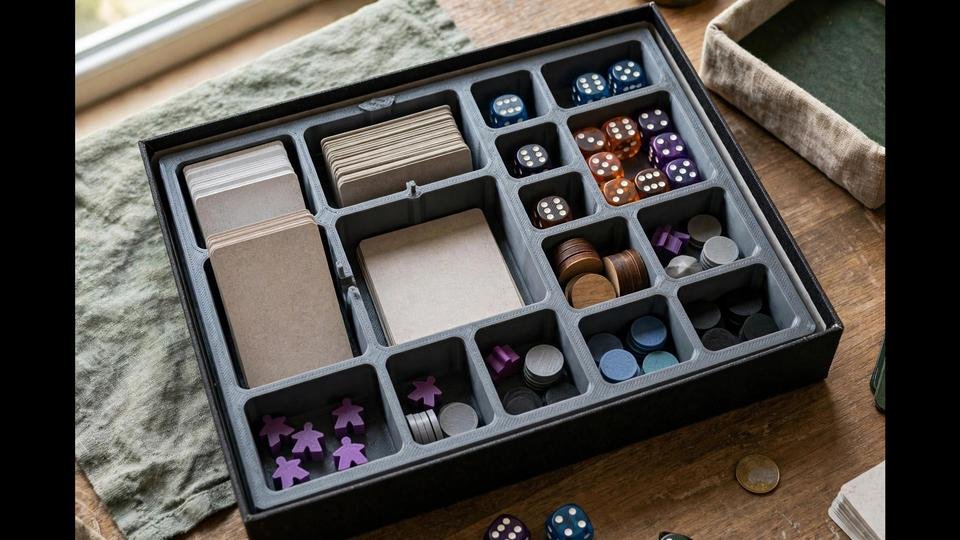
If your board game shelf looks like a cardboard box graveyard — baggies everywhere, setup taking 25 minutes, tokens migrating between compartments — then 3D printed board game inserts are about to become your favourite thing about this hobby. A good insert turns a chaotic box into a tray system where every component has a home, setup drops to minutes, and packing up after game night stops feeling like a chore.
This guide rounds up the best insert designs for the most popular games, shows you where to find the files, and walks through how to print organizers that actually fit — including the measuring, material, and settings choices that separate a great insert from a box of plastic that almost fits.
Why Print Your Own Inserts?
Commercial inserts exist — Folded Space foamcore inserts are the well-known option in Australia, typically $25–$45 AUD per game — and they’re good. But printing your own has real advantages. Cost is the obvious one: a kilo of PLA at $25–$40 AUD prints several inserts, and many designs use well under 500 g of filament. For a big game like Gloomhaven, the saving versus a commercial insert is substantial.
The bigger advantage is choice. The community has designed inserts for hundreds of games, including titles no commercial maker will ever touch, and including every expansion combination you actually own rather than the base game alone. Designs get revised, remixed, and improved by their users — a popular insert on Printables might have a dozen remixes optimised for sleeved cards, for specific expansions, or for faster printing.
And frankly, it’s satisfying. There’s a particular pleasure in opening a game box where every tray lifts out cleanly and every token sits in its labelled slot. If you own a printer, inserts are one of the highest-value things you can make with it — functional prints you and your game group will use for years. Well-designed 3D printed board game inserts are among the few prints that get daily use in most households.
The Best 3D Printed Board Game Inserts by Game
These are proven, widely-printed designs with strong community feedback. Availability of exact designs shifts as creators update them, so search the game name plus “insert” or “organizer” on the file sites below.
Gloomhaven (and Frosthaven)
The king of insert projects. Gloomhaven’s box is enormous, the component count is absurd, and the stock storage is a punched-cardboard joke. A full printed insert for Gloomhaven is a serious undertaking — expect 1.5–2 kg of filament and a week of print time — but it transforms the game from a 30-minute setup ordeal into something you’ll actually get to the table. Look for designs with individual monster trays, tuck boxes for the map tiles, and a dedicated tray for the character components. Frosthaven designs followed quickly after release and apply the same thinking to the bigger box.
Wingspan (with expansions)
Wingspan’s egg-shaped problem is component sprawl: hundreds of cards across expansions, food tokens, eggs, dice, and player mats. The best inserts handle the European, Oceania, and Asia expansions in the base box, with card trays sized for sleeved cards and a removable food tray that goes straight to the table. This is one of the most-printed inserts in the hobby — the designs are mature and the fit is dialled in.
Ark Nova
Ark Nova is the game that makes people buy a printer. Hundreds of cards, a mountain of tokens, and a box that fights you. Printed inserts with labelled token trays and card dividers cut setup dramatically, and the game’s popularity means the designs are excellent — several creators have iterated theirs across multiple versions. If you own the Marine Worlds expansion, check the design supports it before you start printing.
Terraforming Mars
A classic insert candidate: cubes everywhere, player boards that slide, and cards that need sorting. The standout designs include individual player trays (each player’s cubes and markers in one lift-out tray — the single best quality-of-life upgrade in board gaming) plus a central resource bank. The 3D-printed player board overlays that lock cubes in place are a separate but equally worthwhile print.
Brass: Birmingham
Brass has a moderate component count but fiddly bits — the iron, coal, and beer barrels, the tiles, the money. A good insert gives each its own tray and keeps the two player-count setups organised. It’s a smaller print job than Gloomhaven or Ark Nova, making it a great first insert project.
Spirit Island
Spirit Island’s sprawl comes from expansions: base game plus Branch & Claw, Jagged Earth, and Nature Incarnate turns storage into a puzzle. The best inserts are designed around specific expansion combinations, so match the design to what you own. Spirit panels and invader boards need full-size trays — check the design’s box-lid-lift claims against reviews before committing filament.
Everdell
Everdell’s 3D tree is charming and completely incompatible with sensible storage. Printed inserts for Everdell typically replace the tree’s storage role with structured trays for the berries, twigs, resin, and pebbles, plus card storage for the growing deck across the expansions. The Complete Collection big box has its own dedicated designs.
Ticket to Ride
Simpler, but the train pieces and cards benefit enormously from trays — especially the anniversary and Europe editions with their larger components. A quick weekend print that you’ll appreciate every time you play.
| Game | Typical filament needed | Print time (approx.) | First-insert friendly? |
|---|---|---|---|
| Ticket to Ride | 200–300 g | 1–2 days | Yes — great starter |
| Brass: Birmingham | 400–600 g | 2–4 days | Yes |
| Wingspan + expansions | 600–900 g | 4–7 days | Moderate |
| Terraforming Mars | 500–800 g | 3–6 days | Moderate |
| Ark Nova | 800 g–1.2 kg | 5–8 days | Ambitious |
| Gloomhaven | 1.5–2 kg | 7–12 days | Do a small game first |
Print times assume a modern printer running days and evenings — start a tray before work, swap at dinner, and a big insert quietly accumulates over a week or two.
Where to Find Insert Files
- Printables (printables.com) — Prusa’s platform, and the current centre of gravity for board game inserts. Search is good, the reward system means popular designers keep their models updated, and the comment sections are full of fit reports from people who’ve actually printed the design.
- MakerWorld (makerworld.com) — Bambu’s platform, growing fast, with plenty of insert designs and handy print profiles. You don’t need a Bambu printer to download the STLs.
- Thingiverse — the old archive. Still worth searching for older games, but check dates and comments carefully — unmaintained designs with fit problems linger here.
- Designer Patreons and shops — several top insert designers sell premium designs or offer them to supporters. For a game you love, a few dollars for a professionally-designed insert is money well spent.
When choosing between competing designs for the same game, read the comments and check the “makes” (photos of actual prints). A design with 200 makes and fit confirmations beats a prettier render with none. Pay attention to which expansions and which card sleeves the designer built around — “fits sleeved cards” means their sleeves, so check the thickness.
How to Print Inserts That Actually Fit
An insert that doesn’t fit the box is just expensive spaghetti. Here’s how to get it right:
Measure your box, not the designer’s box
Box dimensions vary between print runs and regional editions. Before printing a 30-hour tray set, measure your box’s internal dimensions and compare them to the designer’s stated requirements. Australian editions are usually the same as US/UK, but “usually” has burned people before. One test tray first, then commit.
Material: plain PLA is perfect
Inserts live in a box at room temperature — they need no heat resistance, no UV resistance, no strength beyond holding tokens. Plain PLA is ideal: cheap ($25–$40/kg in Australia), easy to print, and available in every colour. PETG adds nothing here except cost and stringing. Save the fancy filaments for parts that need them — our filament comparison guide covers when each material actually earns its keep.
Settings that matter
- Layer height 0.2 mm. Inserts are big, flat, functional prints — 0.2 mm is the sweet spot of speed and quality. Dropping to 0.12 mm doubles print time for zero functional benefit.
- 2–3 walls, 10–15% infill. Trays don’t need to be strong; they need to be light and fast. Gyroid or grid infill at low density is plenty.
- Print trays flat. Orient parts so the large flat faces are on the bed — better adhesion, no supports, cleaner finish.
- Calibrate flow first. Trays that are supposed to nest or slide need dimensional accuracy. If your printer over-extrudes by 4%, every slot is tight. A quick flow calibration is worth more than any slicer trick.
- Watch for warping on big flat trays. Large footprints can lift at corners. A clean PEI bed, proper first-layer squish, and avoiding cold drafts solve it. If your printer lives in a chilly room, brims are cheap insurance.
Colour-code like you mean it
The best inserts use colour functionally: one colour per player, or distinct colours for token types. You don’t need a multicolour printer — just swap filament between trays, or print different trays in different colours. A $30 spool of red PLA used only for “player one” trays across all your games is one of the best-value purchases in the hobby.
Label everything
Half the value of an insert is knowing where things go at pack-up time. Many designs include embossed labels; where they don’t, a label maker or even neat handwriting on masking tape works. Future-you, packing up at midnight after game night, will be grateful.
Cost Breakdown: Printed vs Bought in Australia
For a mid-size game like Wingspan with expansions: a commercial foamcore insert runs about $30–$45 AUD plus shipping. Printing it yourself uses roughly 700 g of PLA — about $20–$28 of filament at Australian prices — plus electricity (a few dollars for a week of printing) and your time managing the prints. The saving per game is modest, maybe $10–$20.
Where printing wins decisively is scale and selection. After three or four inserts you’ve saved real money — and you can print designs for games no commercial insert exists for.
If you’re still deciding on a printer and inserts are a big part of the plan, any modern bed-slinger or CoreXY machine with a 220 mm+ bed handles trays fine — check our Anycubic Kobra 3 review for one strong option in the current market.
Common Mistakes to Avoid
- Printing the whole insert before a test fit. Print one tray, check it against the box and the components, then print the rest. Designers are human; boxes vary.
- Ignoring sleeve thickness. “Fits sleeved cards” is meaningless without knowing which sleeves. Measure your sleeved cards and compare to the designer’s specs — or print one card tray first.
- Forgetting lid lift. Some designs openly state the box lid sits 5–10 mm proud when everything’s packed. That’s fine if you know, infuriating if you don’t. Check before printing.
- Printing at 0.12 mm “for quality”. You’ll double a week-long print into a two-week print for trays that look identical in the box. Save fine layers for miniatures.
- Using PETG “to be safe”. It strings, it’s slower, it costs more, and it buys you nothing in a box insert. PLA. Always PLA for inserts.
For broader board gaming context — ratings, forums, and which games are actually worth the insert effort — BoardGameGeek remains the hobby’s indispensable database and community.
3D Printed Board Game Inserts: FAQs
How much filament does a board game insert use?
It depends on the game. Small games like Ticket to Ride need 200–300 g; mid-size games like Wingspan or Terraforming Mars use 500–900 g; monsters like Gloomhaven can take 1.5–2 kg. At Australian PLA prices of $25–$40/kg, most inserts cost $10–$35 in filament.
What material should I use for 3D printed board game inserts?
Plain PLA. Inserts sit in a box at room temperature and need no heat resistance or extra strength. PLA is the cheapest, fastest-printing, easiest option. PETG and ABS add cost and printing difficulty for zero benefit in this application.
Where can I download board game insert files?
Printables is the best source, with MakerWorld growing fast and Thingiverse useful for older games. Search the game name plus “insert” or “organizer”, and favour designs with lots of “makes” — photos proving real people printed it successfully — over pretty renders with no print history.
Will a printed insert fit my Australian edition of the game?
Usually, but verify. Box dimensions can vary between print runs and regional editions. Measure your box’s internal dimensions, compare with the designer’s specs, and print one test tray before committing to a full multi-day print.
Do I need a multicolour printer for board game inserts?
No. Colour-coding is done by swapping filament between trays — print player one’s trays in red, player two’s in blue, and so on. A single-colour printer handles inserts perfectly; multicolour only matters for decorative multi-colour single parts.
Are printed inserts cheaper than buying Folded Space inserts?
Per game, modestly — you might save $10–$20 on a mid-size game after filament and power. The real win is across your whole collection: once you own the printer, every insert is cheap, and you can print designs for games no commercial insert exists for.