Your kitchen is full of small annoyances that mass manufacturing never bothered to solve — the drawer that won’t stay organised, the bag that won’t stay closed, the spice jars you can’t identify. 3D printed kitchen gadgets fix exactly these problems, custom-fit to your space and printed for cents. In this guide, I’ve rounded up the 15 most useful 3D printed kitchen gadgets for 2026, with food-safety guidance, the best free STL sources, and print settings that actually work.
But first, the question everyone asks:
Are 3D Printed Kitchen Gadgets Food Safe?
The honest answer: it depends on the use. Here’s the practical breakdown:
- Food-contact items (cookie cutters, spatulas that touch food): use PETG — it’s the most food-safe common filament. PLA is technically food-safe as a raw material, but its layer lines harbour bacteria and it softens in hot dishwashers. Avoid ABS for food contact.
- Non-contact organisers (drawer dividers, bag clips, holders): any filament works, PLA included.
- The layer-line caveat: FDM prints have microscopic grooves where bacteria can hide. For items touching food, keep them smooth, wash by hand, and replace periodically. Don’t use printed items for long-term food storage.
- Nozzle note: Standard brass nozzles contain trace lead. If you’re serious about food contact, a stainless steel nozzle is a cheap upgrade.
With that covered, here are the prints worth your filament.
Organisation Gadgets
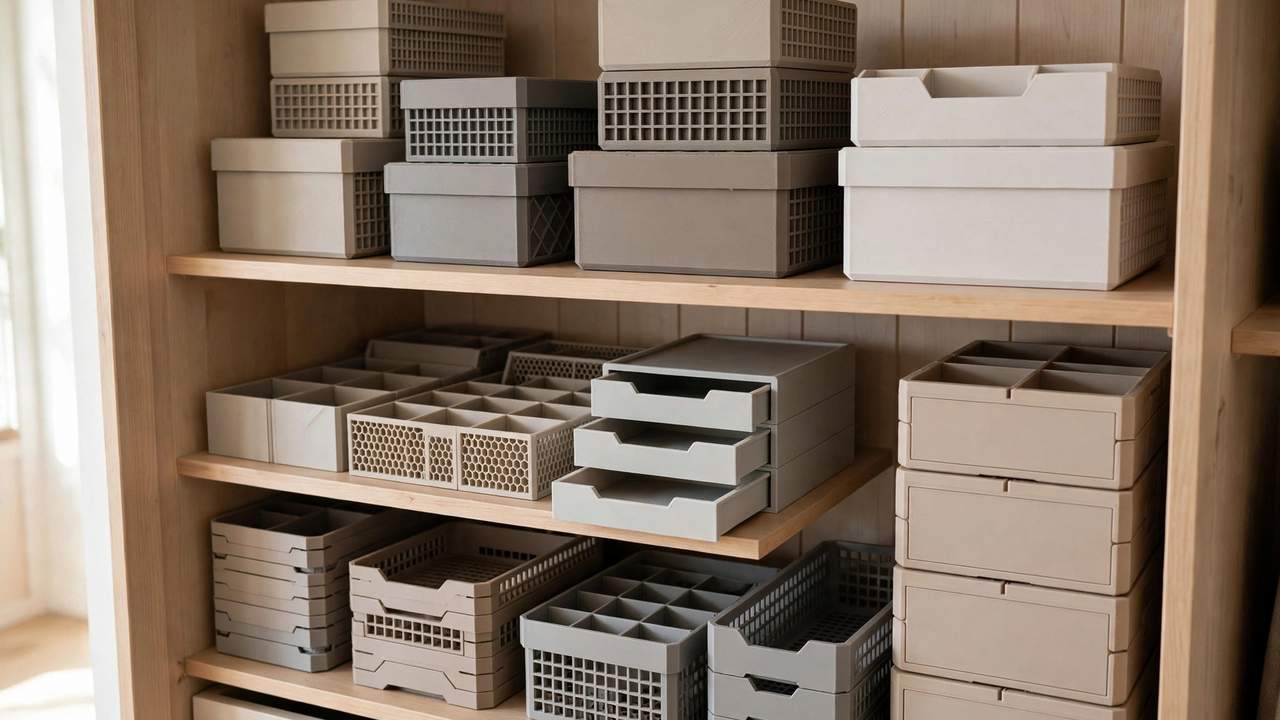
1. Custom Drawer Organisers
The single highest-impact kitchen print. Measure your drawers once, design (or download and scale) dividers that fit exactly — no more rattling cutlery trays that are 2 cm too short. Gridfinity-style modular bins are the 2026 standard; the ecosystem of free bins, dividers, and labels is enormous.
2. Spice Jar Labels and Racks
Print a tiered rack sized to your exact jars, plus embossed labels. Multi-colour printers (or a simple filament change at the text layer) make labels that look genuinely professional.
3. Bag Clips in Every Size
The humble bag clip is the “hello world” of functional printing — fast, useful, and customisable. Print a family of sizes for everything from chip packets to 5 kg flour bags. They print in under 30 minutes and cost cents in filament.
4. Fridge Door Organisers
Clip-on bins and bottle holders that grip your specific fridge shelves. Measure twice, print once — a wobbly fridge print is a lesson in tolerances you’ll only need once.
Cooking Helpers
5. Cookie Cutters (PETG Only)
Custom cookie cutters are the killer demo of 3D printing: any shape imaginable, printed in an hour. Use PETG, keep wall thickness generous for rigidity, and hand-wash. Kids’ birthday parties will never be the same.
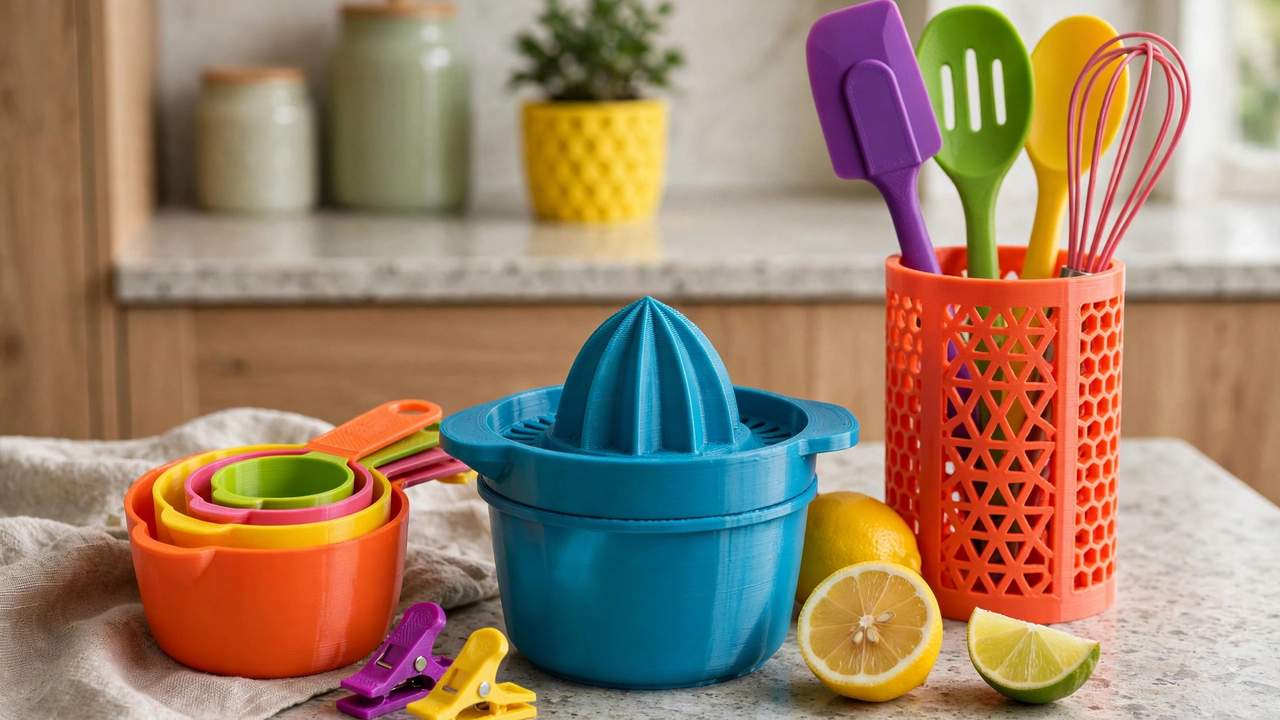
6. Measuring Cups and Spoons
Print the odd sizes your shop-bought set skipped — the ⅔ cup, the 2.5 ml spoon. Engrave the measurements into the model so they never wear off. PETG for durability.
7. Jar Opener Grips
A simple textured grip that multiplies your torque on stubborn lids. Print in TPU for the grippy version — it’s one of the best beginner TPU projects because the geometry is forgiving.
8. Custom Funnels
Need a funnel with an odd diameter for decanting into a specific bottle? Five minutes of CAD (or a parametric model from Printables) beats a trip to the shops.
Cleaning and Maintenance
9. Dish Sponge Holders
A ventilated holder that keeps sponges dry between uses. Design in drainage slots — standing water is the enemy. PLA is fine; it’s not food-contact.
10. Sink Caddy Dividers
Stop your brushes and bottles sliding around the sink. A fitted caddy insert takes one measurement and one print.
Clever Upgrades
11. Paper Towel Holder Adapters
Oversized or undersized paper towel rolls? Print adapter rings. It’s the kind of 10-cent fix that feels like magic.
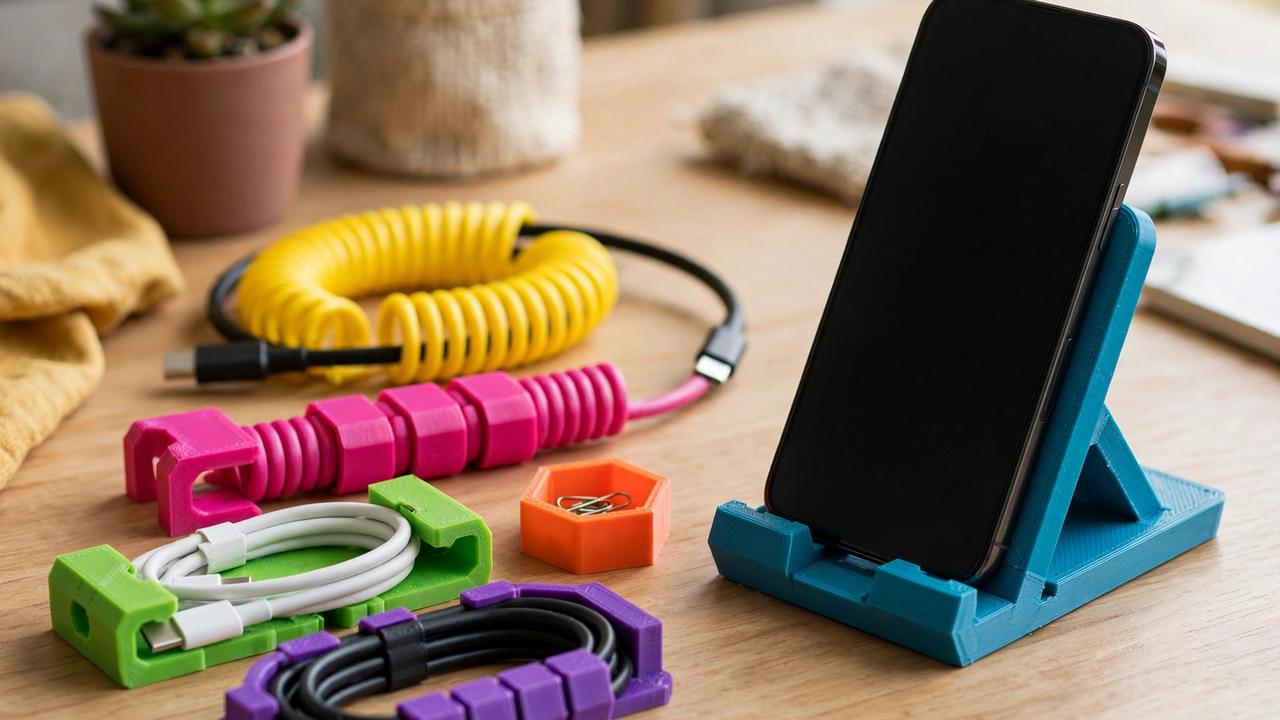
12. Cable and Charger Dock
Kitchen bench charging station with fitted slots for each family member’s phone. Keeps devices away from the cooking zone.
13. Herb Stripper
A small multi-holed tool that strips thyme, rosemary, and parsley stems in one pull. Print in PETG, hand-wash.
14. Egg Holders and Protectors
Custom egg crates for camping, or stackable protectors that stop eggs rolling in the fridge door.
15. Knife Blade Guards
Fitted blade guards for your good knives — safer drawers, protected edges. Size them to each blade and add a snug friction fit.
Where to Find Free STL Files
- Printables.com — Prusa’s library; excellent search and the best-organised kitchen collection
- MakerWorld — Bambu Lab’s library; great for multi-colour kitchen models
- Thingiverse — the old giant; huge archive but variable quality, check comments before printing
- Thangs — good search across multiple sources
Pro tip: search with specific terms (“gridfinity bin 2×3”, “PETG cookie cutter”) rather than generic ones. And always check the “makes” or comments — a model with 50 successful prints is a safer bet than an untested one.
Best Print Settings for 3D Printed Kitchen Gadgets
- Material: PETG for anything touching food or needing heat/water resistance; PLA for dry organisers
- Walls: 3–4 perimeters for strength (kitchen items get abused)
- Infill: 20–30% gyroid for functional parts; 10–15% is fine for light organisers
- Layer height: 0.2 mm is the sweet spot; 0.28 mm for fast draft organisers
- Food-contact extras: consider a food-safe epoxy coating for items in regular food contact — it seals layer lines
Verdict
3D printed kitchen gadgets are the perfect gateway to functional 3D printing: small, fast, immediately useful, and endlessly customisable. Start with bag clips and drawer organisers, graduate to PETG cookie cutters, and within a month you’ll be looking at every kitchen annoyance as a design brief. That’s when the real fun starts.
New to functional printing? Start with our 3D printing beginner guides for material and slicer basics.
Designing Your Own Kitchen Gadgets
Downloaded models cover 80% of needs — but the real magic starts when you design for your kitchen. You don’t need engineering credentials; here’s the practical path:
- Start with Tinkercad (free, browser-based): perfect for simple brackets, hooks, spacers, and adapters. If you can drag boxes and cylinders, you can design a custom hook in 10 minutes.
- Learn parametric basics in Fusion 360 (free for hobbyists): for fitted parts like drawer organisers, parametric dimensions mean you measure once and the model adapts — change one number, everything updates.
- The cardboard prototype trick: before printing a complex organiser, mock it up in cardboard. You’ll catch fit issues in 5 minutes that would cost a 6-hour print.
- Measure with calipers, not rulers: a $20 digital caliper is the highest-ROI tool in 3D printing. Kitchen fittings need 0.5mm accuracy; rulers can’t deliver that.
The tolerance rule for kitchen fits
Printed parts shrink slightly and have layer texture, so design clearances deliberately:
- Snug press-fit: 0.1–0.2mm clearance per side
- Sliding fit (drawer dividers): 0.3–0.5mm per side
- Loose fit (lids, caps): 0.5–0.8mm per side
When in doubt, print a small tolerance test piece first — a 20-minute test beats a 6-hour reprint.
Australian Kitchen Print Ideas
Some prints solve specifically Australian problems:
- Fly-screen door handles: those flimsy plastic handles break constantly; print beefed-up replacements in PETG
- Espresso machine accessories: custom tampers stands, dosing funnels sized to your portafilter, knock box inserts — Australia’s coffee culture is a print goldmine
- Weber/BBQ accessories: tool hooks, thermometer holders, and chimney starter handles sized to your exact grill
- Pantry moth traps holders: fitted holders for the traps every Australian pantry seems to need in summer
- Pool-adjacent kitchen items: outdoor kitchen prints need ASA or PETG (see our waterproofing guide) — drink holders, BBQ caddies, poolside table accessories
Batch Printing: Stocking Up Efficiently
Once you’ve dialled in a useful gadget, print in batches:
- Fill the bed: arrange multiple copies with even spacing — 8 bag clips print in barely more time than 2
- Sequential printing (one at a time) reduces stringing between copies and contains failures — if copy 6 fails, copies 1–5 are already done
- Gift batches: printed kitchen gadgets make genuinely appreciated gifts — a set of custom cookie cutters or measuring spoons costs dollars and looks thoughtful
Kitchen Prints as Gifts: A Cheat Sheet
Printed kitchen gadgets punch far above their cost as gifts:
- Housewarming: custom drawer organiser set + measuring spoons in their favourite colour — personal and practical
- Kids’ birthdays: themed cookie cutters (dinosaurs, space, animals) in a printed gift box
- BBQ lovers: custom tool hooks, thermometer holder, and a bottle opener in PETG
- Coffee nerds: portafilter dosing funnel, tamper stand, knock box — the holy trinity
- Christmas: batch-print bag clips and cookie cutters in festive colours; pair with actual cookies for maximum effect
Presentation matters: a $2 print in a nice box with a handwritten card reads as thoughtful, not cheap. Remove all brim/raft remnants and give functional prints a quick sand on touch surfaces.
Filament Picks for 3D Printed Kitchen Gadgets (Australia)
- Best budget PLA: eSUN PLA+ — tough, consistent, widely stocked by AU resellers (~$30–$35/kg)
- Best PETG: look for dimensionally consistent PETG from established brands; expect $35–$45/kg locally. Dry it before food-contact prints.
- Best TPU: 95A hardness TPU from reputable makers — softer 85A is grippier but harder to print; 95A is the sweet spot for jar openers and grips
- What to avoid: no-name ultra-cheap filament for anything functional — inconsistent diameter causes weak spots exactly where kitchen items take stress
- Buying tip: Australian 3D printing specialists (not just marketplaces) sell fresher stock with less moisture exposure — worth the small premium for PETG especially
Kitchen Print Settings Cheat Sheet
- Bag clips / small gadgets: PLA, 0.28mm layers, 15% infill, 2 walls — fast and strong enough
- Drawer organisers: PLA, 0.2mm, 10% infill, 2 walls — rigidity comes from geometry, not plastic
- Cookie cutters: PETG, 0.2mm, 3 walls, 20% infill — stiff cutting edge matters
- Measuring cups: PETG, 0.2mm, 4 walls, 30% infill — they get knocked around
- TPU grips: 95A TPU, 0.2mm, slow (25mm/s), no retraction or minimal — patience required
- Sponge holders: PETG, 0.2mm, drainage slots in design, 3 walls
Save these as slicer presets named “Kitchen PLA” and “Kitchen PETG” — you’ll reuse them constantly.
Storing Filament in Australian Humidity
Kitchen-adjacent printing means steam and humidity — filament care matters:
- Sealed tubs with desiccant: the standard; rechargeable silica gel beads change colour when spent
- PETG is the priority: it absorbs moisture fastest and prints worst when wet — popping, stringing, weak layers
- Dry before critical prints: a filament dryer (~$60–$90 AUD) pays for itself in saved failed prints
- Coastal Queensland/NSW makers: you need active drying, not just storage — ambient humidity defeats passive desiccant quickly in summer
Start tonight: pick one annoyance in your kitchen — just one — and search Printables for it. Print it tomorrow. That single useful object will teach you more about functional 3D printing than any guide, because you’ll immediately start noticing the next annoyance. Within a month, you’ll have a drawer full of custom solutions and a completely different relationship with your printer. The kitchen is where 3D printers earn their keep.
Printed kitchen gadgets also make brilliant market stall fillers if you ever try selling at local markets — low cost, high perceived value, and they demonstrate your printer’s capabilities to potential custom-order customers.
Frequently Asked Questions
Is PLA food safe for 3D printed kitchen gadgets?
PLA is food-safe as raw material, but layer lines harbour bacteria — best for non-contact organisers. Use PETG for food-touching items, hand-wash, and replace periodically.
What is the best filament for 3D printed kitchen items?
PETG — durable, water-resistant, top-rack dishwasher tolerant, and the most food-safe common filament. PLA for dry organisers.
Where can I download free 3D printed kitchen gadget files?
Printables.com and MakerWorld have the best kitchen collections; Thingiverse has the biggest archive (check comments first).
Can you put 3D prints in the dishwasher?
PLA warps — hand-wash only. PETG usually survives the top rack, but hand-washing extends any print’s life.
How much does it cost to 3D print kitchen gadgets?
Cents to a few dollars in filament — a bag clip is under 50 cents at Australian filament prices.
For food-contact material safety information, see Food Standards Australia New Zealand.