Resin 3D Printing Safety: Ventilation, PPE and Waste Disposal in Australia
Resin printers make the sharpest miniatures of any home printer — and they are the one type that can genuinely hurt you if you treat it like a filament machine. The liquid in the vat is not ink: it is acrylate monomers that irritate skin, can trigger a lasting allergy, and give off vapours you should not breathe all day. This guide to resin 3d printing safety australia covers ventilation, gloves, respirators, washing, curing, and legal waste disposal.
Why Resin Demands More Care Than Filament
Filament is solid plastic. Resin is a reactive chemical that only becomes plastic when UV light cures it, and while it is still liquid, most desktop resins are classified as skin irritants and skin sensitisers. The Australian safety data sheets agree: skin irritation, allergic skin reaction, serious eye irritation, and long-term harm to aquatic life.
Sensitisation is the part most new owners miss. The first time resin touches your skin, you might get nothing worse than redness — but the reaction is cumulative, and once sensitised, even a tiny splash can bring up a rash that lasts days. The US National Institute for Occupational Safety and Health (NIOSH) warns that uncured resin contains acrylates that can cause asthma or dermatitis, and the risk comes from pouring, handling and cleaning, not just printing. Resin also releases volatile organic compounds (VOCs) while it prints, strongest when the lid comes off and around the wash station, where isopropyl alcohol (IPA) adds its own irritation. You will not always smell them — “low odour” does not mean no vapour.
Resin 3D Printing Safety Australia: Your Ventilation Setup
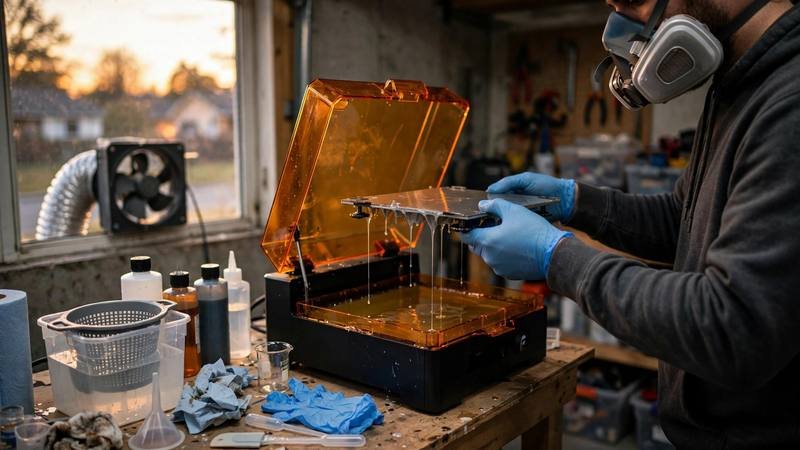
Ventilation is the first control, before gloves and respirators, because it deals with the vapours at the source. The standard is external ducted exhaust: a sealed enclosure or fume hood with a fan that sends room air outside. A 100 mm inline duct fan vented through a window is the setup most home workshops use. A carbon pad saturates fast, and an unvented enclosure concentrates the fumes and releases them in one burst the moment you open the door.
| Ventilation setup | How well it works | Notes |
|---|---|---|
| Vented enclosure, exhaust to outdoors | Best | The standard for resin |
| Open window plus exhaust fan | Good | Fan blowing out through the window |
| Separate room, door closed, exhaust running | Good | Slight negative pressure |
| Carbon-filter-only enclosure | Moderate | Filters saturate fast |
| Ceiling fan or desk fan | Poor | Removes nothing |
Keep the printer lid on while it prints, and let it air out for a few minutes before opening it. A garage or shed suits a resin printer, as long as the temperature stays in the 20 to 25°C range: cold resin gets thick and prints fail. Keep the wash station in the same ventilated area: the IPA bath gives off as much vapour as the vat.
PPE: What to Wear Every Single Time
Gloves are not optional with resin, and not all gloves count. Nitrile works: 5 mil or thicker, powder-free. Thin nitrile (2 to 3 mil) lets resin through within minutes, latex lets the monomers pass readily, and vinyl is poor. Tests on a common ABS-like resin found 5-mil nitrile breached in about 12 minutes and 8-mil in about 35 — which is why the rule is to change gloves often, every 15 to 30 minutes, or immediately after any contact. Double-glove for plate removal and part transfer, and cover your wrists — the most common exposure point. That is the glove rule at the heart of resin 3d printing safety australia: change them before they fail, not after.
| Glove type | Resin protection | Verdict |
|---|---|---|
| Nitrile, 5–8 mil | Good for short contact | Best everyday choice |
| Nitrile, 2–3 mil | Permeates within minutes | Change often |
| Latex | Poor, monomers pass through | Avoid |
Wear splash-rated safety glasses or goggles whenever you pour resin, remove the build plate, or wash parts — regular prescription glasses do not count, because they leave the sides open. A half-face respirator with organic vapour cartridges (and a P100 filter for sanding) matters most during post-processing, or any time you work without exhaust ventilation. A paper dust mask does not filter vapours at all.
Handling Uncured Resin Without Touching It
Most skin contact happens in a handful of moments: pouring resin, lifting the build plate, scraping a failed print off the film, and cleaning the vat. Pour with a funnel where you can, over a tray, and keep paper towel and IPA within reach. Never touch uncured resin with bare hands, even for a second, and never use IPA to wash resin off your skin — it drives the monomers deeper in. Soap and cool water is the correct wash. Clean up spills straight away with disposable wipes and IPA, and store resin bottles upright, away from light and heat, where children and pets cannot reach them.
Washing and Curing Parts Safely
Washing is where most people get their biggest exposure, because the parts come out dripping and the wash bath is open. Keep wash containers sealed when you are not using them, and move parts in and out without splashing. IPA is flammable, so keep the wash station away from heaters, naked flames and sparks. Water-washable resins avoid IPA altogether, but the wash water is not harmless: it carries dissolved uncured resin, so never tip it down a sink or drain — leave it in a clear container in sunlight or under a UV lamp until the resin cures and settles, then follow your council’s guidance for the liquid. Cure every part fully before you handle it bare-handed or sand it: a part that is still tacky is still chemically active. Sanding throws up dust that can contain uncured resin particles, so wear the respirator and do it in the ventilated area, not at the kitchen table.
Waste and Disposal in Australia
This is the part that catches new owners out: you cannot pour anything resin-related down a drain, sink, or toilet, and you cannot put uncured resin in the bin. Uncured resin is a chemical waste, harmful to aquatic life with long lasting effects. The fix is the one every Australian guide and every resin SDS agrees on — the core rule of resin 3d printing safety australia: cure it first, then dispose of the solid.
| What you have | What to do with it |
|---|---|
| Failed prints, supports, cured parts | Bin in general waste once fully cured |
| Uncured resin, drips, used gloves and wipes | Cure in sunlight or UV first, then bin |
| Used IPA or wash water with resin in it | Leave in sun to cure and settle; follow council guidance |
| Empty resin bottles | Leave open in sunlight so residue cures, then bin |
| Large amounts of uncured resin | Take to a Household Chemical CleanOut |
The home method, described by 3D Printer Australia, is to keep a bag in the printing room for anything that has touched resin. When it fills up, cut it open somewhere sunny, out of reach of people and pets, and leave everything in direct sunlight for at least 48 hours. Once fully cured it is a solid plastic, and it can go in the regular red bin.
For anything you cannot cure at home, use your state’s chemical waste service. New South Wales runs a free Household Chemical CleanOut program — find a drop-off date on its website or call the NSW environment line on 131 555 — and Victoria runs a similar one. Check your local council’s website, and read Section 13 of your resin’s safety data sheet. Our guide to recycling failed prints in Australia covers the cured side of the waste stream, and the disposal guide at 3D Printer Australia walks through the three disposal options in detail.
Where to Put the Printer
The printer belongs in a room you do not sleep or eat in, door closed and exhaust running while it prints. A garage, shed or dedicated workshop room is ideal. Keep it away from children and pets — the resin, the UV light inside the printer and the wash station are all hazards. If you are still choosing between printer types, our comparison of resin vs FDM printing covers the safety trade-offs, and our guide to the best budget resin 3D printers in Australia notes which models come with built-in filtration. If you print toys, our guide to safe 3D printed toys for kids covers what counts as child-safe once a print is fully cured.
First Aid: Skin, Eyes and Breathing
Even with good habits, a splash happens eventually. If resin gets on your skin, wash it off straight away with plenty of soap and cool water — not IPA, not acetone, not hand sanitiser. Take off contaminated clothing and wash it before reuse. If redness, itching or a rash shows up, get medical advice and tell the doctor it was uncured photopolymer resin. If the rash keeps coming back after small exposures, stop handling resin and see a doctor — that is what sensitisation looks like.
If resin gets in your eyes, rinse cautiously with water for several minutes, remove contact lenses if you wear them, and keep rinsing. If irritation persists, get medical attention. If someone breathes in a strong concentration of vapour and feels dizzy, nauseous or short of breath, move them to fresh air and call for help if it does not clear. In Australia, the Poisons Information Centre is on 13 11 26, 24 hours a day — call them even if there are no symptoms yet. If someone has collapsed or stopped breathing, call 000 straight away.
Your Resin Safety Setup
That is the whole system for resin 3d printing safety australia: exhaust ventilation outdoors, nitrile gloves changed often, splash goggles, a respirator for post-processing, soap and water for skin, sealed wash containers, full curing before handling, and cure-before-you-bin for all waste.
Frequently Asked Questions
Do I need a respirator for resin 3D printing?
Yes, for post-processing at least. A half-face respirator with organic vapour cartridges is the recommended protection when you wash parts, remove supports or sand, or whenever you work without exhaust ventilation. A paper dust mask does not filter vapours.
Can I pour resin or used IPA down the drain?
Never. Uncured resin is harmful to aquatic life with long lasting effects, and no amount is safe to tip down a sink, drain or toilet. Cure it first — sunlight or UV light until it is solid — then bin it in general waste. For used IPA or wash water, leave it in the sun so the dissolved resin cures and settles, then follow your council’s guidance.
What gloves should I wear for resin printing?
Powder-free nitrile gloves, 5 mil or thicker. Latex and vinyl let resin monomers through too easily, and thin 2 to 3 mil nitrile is breached within minutes. Change gloves every 15 to 30 minutes, or immediately after any contact, and double-glove for plate removal and part transfer.
Is cured resin safe to throw in the bin in Australia?
Yes, once it is fully cured. Fully cured resin is a solid plastic and can go in the regular red bin with general waste. Leave scraps, supports, gloves and empty bottles in direct sunlight for at least 48 hours, or under a UV lamp, so the light reaches every surface, including the inside of bottles. For uncured resin, use a Household Chemical CleanOut event or your council’s chemical waste service.
What should I do if resin gets on my skin?
Wash it off immediately with plenty of soap and cool water — never use IPA or solvent on your skin, as it drives the resin deeper in. Remove contaminated clothing and wash it before reuse. If redness, itching or a rash appears, get medical advice and mention it was uncured photopolymer resin. If you are unsure, call the Poisons Information Centre on 13 11 26.