3D Printed Concrete in Australia: Real Homes, Real Costs, Real Limits
A house whose walls went up in 18 hours sounds like a trade-show stunt — until you learn people are living in one in Perth, and a government paid $814,000 for two more in Dubbo. The gap between a printed demo wall and a home you can actually live in is the whole story of 3d printed concrete australia. The houses are real — and so are the limits.
How 3D Concrete Printing Works
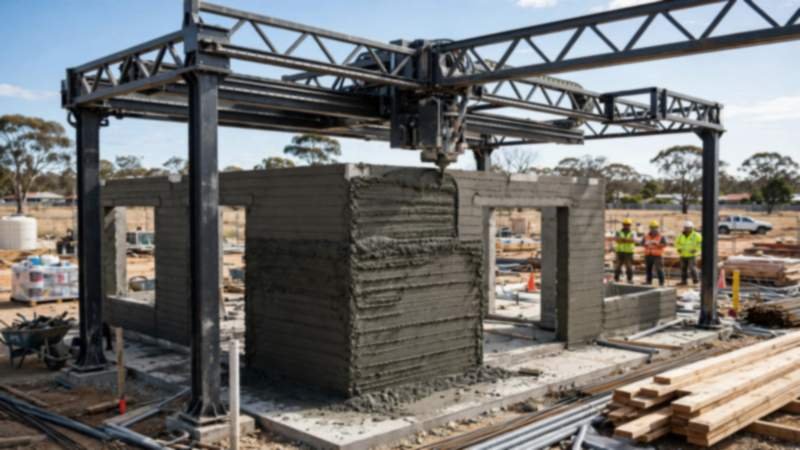
A concrete printer is a large-format version of the machine on your desk. A gantry frame or a robotic arm carries a nozzle along a programmed path, laying down a cement-based mix in beads — typically 20 to 40 mm wide and 8 to 15 mm tall — layer on layer until a wall stands. There is no formwork and no mould: the wall is the shape the toolpath says it is, curves and all.
The mix is the hard part. It has to flow like a liquid while it is pumped, then stiffen the moment it leaves the nozzle so it can hold the next layer — a property called thixotropy. Contour3D’s ContourCrete is technically a mortar rather than a concrete, because every aggregate in it is 5 mm or smaller. Get the mix wrong and the wall sags.
What gets printed is the walls. Foundations, roofs, plumbing, wiring and finishing are still conventional work, done by crews after the printer leaves. Like any concrete, it still needs around 28 days to reach full strength.
3D Printed Concrete Australia: The Homes Already Standing
The first one to clear the engineering bar was Luyten’s Heptapod in Melbourne, finished in December 2021. Luyten calls it Australia’s first code-compliant 3D-printed home: the structure was printed over two days with the Platypus Expeditionary printer, assembled on site on the third day, and engineered to AS/NZS 1170. Read Luyten’s own account in their Heptapod write-up.
Contour3D’s GENESIS duplex in Woolooware, Sydney, is the residential project most Australians will have seen. The ground-floor walls — 1,310 square metres — were printed from around 140 tonnes of ContourCrete: local aggregates, cement with 30% fly ash, and the company’s “Pixie Dust” admixture. The material reaches 56 MPa with a 50-plus-year design life. Contour3D calls GENESIS Australia’s first full-scale 3D-printed residential building.
The fastest build so far belongs to Contec Australia in Tapping, Perth: the country’s first multi-storey 3D-printed concrete house, with both floors’ structural walls printed in just 18 hours. The full build still took five months. Contec’s mix sets hard in under three minutes, reaches 50 MPa — over three times the strength of brick — and the company says the home is cyclone-rated, fire-resistant and termite-proof.
The project that matters most for ordinary buyers is in Dubbo, New South Wales: two modern two-bedroom duplexes, the country’s first 3D-printed social housing, built by Contour3D with Aboriginal Sustainable Homes. The walls were printed in 16 days and the whole project took around 20 weeks, against an initial prediction of 40. It finished in May 2025, cost the government $814,000, and came in an estimated 10 to 20% cheaper than a traditional build.
Luyten is now going taller. Its multi-storey home in Wyndham, in Melbourne’s outer west, is a 350-square-metre, four-bedroom house being printed by the Platypus X12 crane printer, due to finish in five weeks against the usual eight to eleven months. Printing started in a Melbourne summer of 35 to 42 degree heat and frequent storms. Chief executive Ahmed Mahil says three comparative quotes put the printed build 25 to 30% cheaper.
| Project | Location | What was printed | Print time | Cost note |
|---|---|---|---|---|
| Heptapod (Luyten) | Melbourne, VIC | Full one-bedroom dwelling structure | 2 days print, 1 day assembly | First code-compliant under AS/NZS 1170 |
| GENESIS duplex (Contour3D) | Woolooware, NSW | Ground-floor walls, 1,310 sqm | Not published | Demonstration residential build |
| Two-storey home (Contec) | Tapping, WA | Both storeys’ structural walls | 18 hours | 22% cheaper than local masonry build |
| Social housing duplexes (Contour3D) | Dubbo, NSW | Walls of two two-bedroom duplexes | 16 days | $814,000; 10–20% cheaper |
| Multi-storey home (Luyten) | Wyndham, VIC | 350 sqm four-bedroom home | 5 weeks (full build) | Quotes 25–30% cheaper (company claim) |
What a Printed Home Costs
The honest answer on 3d printed concrete australia is that the walls are only part of a home, and the walls are the only part the printer makes cheaper. Contour3D says it plainly in its own FAQs: printed homes are “not automatically” cheaper, because foundations, roof, services, fit-out, land and certification all carry conventional costs. The company prices each project individually and publishes no per-square-metre figure.
The project evidence points the same way. The Dubbo duplexes came in 10 to 20% cheaper than a traditional build; Contec reports its Perth two-storey home at 22% below a standard local masonry build; Luyten’s chief executive says his own multi-storey house was quoted 25 to 30% cheaper. A Western Sydney University analysis published in January 2026 modelled a 120-square-metre modular 3D-printed home and found upfront costs around 20 to 30% lower, build time 50 to 70% shorter, material use about 40% lower and embodied emissions about 55% lower.
The sharpest savings are in the walls themselves. Luyten’s chief executive has claimed the walls of a 250-square-metre house cost $12,000 to print, against $60,000 to $80,000 traditionally, and a wall section 2.5 metres long, 1 metre high and half a metre wide costs about $160 against $1,300 to $1,800 in brick and mortar. Those are 2021 company claims, not audited prices.
If you are budgeting, the right question is not “what does a printed home cost per square metre” but “what does my project cost printed versus conventional, with the same finishes”. Get both quotes for the same design — the printing saving is real, but it sits inside a conventional build. Our guide to pricing 3D printed products in Australia covers the same discipline at hobbyist scale.
What 3D Printed Concrete Australia Can’t Do Yet
Reinforcement is the biggest open engineering question. A printed bead cannot wrap a steel rebar cage the way formwork can, so reinforcement has to be added another way: a printed cavity filled with cast concrete and steel, post-tensioned rods threaded through vertical voids, or short fibres mixed into the paste. America’s NIST names the layer interface as the main concern for strength and durability, so printed walls are tested as a system — machine, mix and structure together — not as generic concrete.
Geometry has hard limits too. Overhangs leaning more than roughly 30 to 45 degrees from vertical need support, a printed corbel or a redesign, because a bead cannot float. A printed roof can be built as an arch, but a flat slab needs reinforcement and temporary support — which brings back the formwork the printer was meant to avoid. Thin features are fragile: a 60 mm wall prints cleanly, while a 25 mm fin can wobble and snap during handling.
Approvals are the slowest part of all. Most jurisdictions have no prescriptive path for a printed load-bearing wall, so each building goes through the standard Australian approval pathway — a development application or complying development certificate, engineering sign-off and a Principal Certifying Authority — and must comply with the National Construction Code and the relevant Australian Standards. That is how the Heptapod, GENESIS and Dubbo projects were approved. No dedicated 3D-printing standard exists in Australia yet, so expect months of paperwork before a single layer is placed.
Precision is the last honest limit. Printed walls commonly land within about 5 to 15 mm of their intended position and thickness, and the surface carries a visible layer texture. Anything that must bolt, seal or slide needs finishing after curing.
Can a Hobbyist Print Concrete at Home?
Not a house. The machines that print houses are gantry printers the size of a building site or crane printers towering over a suburban street, fed by mobile batching plants — not something that fits in a garage. But the smaller end of the same technology is within a maker’s reach.
Desktop clay printers are the entry point. The 3D PotterBot Micro 10, sold in Australia by Geotecture, is a compact ceramic printer with a 1,000 ml clay extruder and a build envelope of about a foot, listed from AU$5,750 — enough for planters, vases, tiles and test forms in real clay. The same maker’s Scara Elite is purpose-built for cementitious materials, with a pump-fed arm for larger pieces.
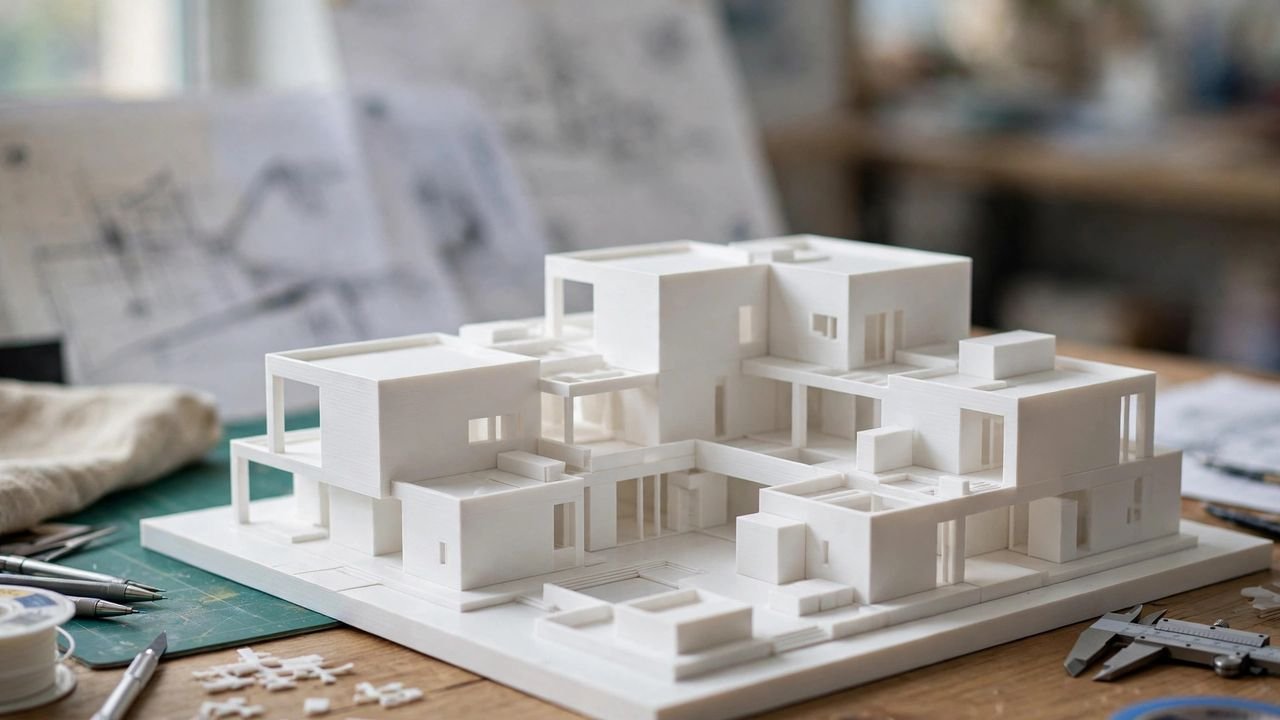
There is also a middle path that needs no machine at all: order factory-printed pieces. Contour3D prints concrete products to order in its New South Wales factory — retaining walls, planters, seating and fire rings — delivered ready to place. Print a scale model first — our guide to 3D printing architectural scale models covers the workflow. Our 3D printing business ideas in Australia guide covers turning prints into sales.
Where the Technology Goes Next
The supply side is catching up. Danish printer maker COBOD signed Australian company Fortex as its distributor in 2022, with the first BOD2 5-9-2 construction printer due in Australia later that year, and COBOD now has customers on six continents. Contour3D builds its own OPUS gantry printer in Sydney and runs its own slicer and cloud platform, so the whole stack — printer, software and mix — is now Australian-made. More 3D-printed social housing is planned after Dubbo. For a hobbyist, the useful skill is understanding the process, not operating the crane.
Frequently Asked Questions
How much does a 3D printed house cost in Australia?
There is no published per-square-metre price for 3d printed concrete australia — no Australian company publishes one, and each project is priced individually. The evidence so far: 10 to 20% cheaper for the Dubbo duplexes, 22% cheaper for Contec’s Perth home, and 25 to 30% cheaper on quotes for Luyten’s multi-storey house.
Are 3D printed concrete houses safe and legal in Australia?
Yes, when engineered and approved like any other home. Luyten’s Heptapod was engineered to AS/NZS 1170 and is code-compliant. Each building goes through the standard pathway — development application or complying development certificate, engineering sign-off and a Principal Certifying Authority — under the National Construction Code and the relevant Australian Standards.
How long does it take to 3D print a house?
Printing the walls is fast: Contec printed a two-storey home’s structural walls in 18 hours, Luyten printed the Heptapod structure in two days, and the Dubbo duplex walls took 16 days. The full build is much slower — five months for Contec’s Perth home including roofing, wiring and interiors, and around 20 weeks for Dubbo.
Can I 3D print concrete on a home printer?
Not a house. House printers are gantry or crane machines fed by batching plants, far beyond a garage setup. What you can print at home is small-scale work: desktop clay printers such as the 3D PotterBot Micro 10, listed from AU$5,750 in Australia, print planters, vases and tiles in real clay, and larger cement-capable machines exist for garden pieces.
Is 3D printed concrete cheaper than brick?
The walls are, but the whole home is not automatically cheaper. Printed wall sections cost far less than brick and mortar — Luyten claims about $160 against $1,300 to $1,800 conventionally — yet foundations, roof, services, fit-out and certification still carry conventional costs. Reported project savings run 10 to 30%.