Every maker with a 3D printer has had the thought: what if this thing paid for itself? Friends ask you to print things, someone on Facebook Marketplace wants a quote, and suddenly you’re wondering whether to start 3D print farm business Australia-style — a row of machines humming away, turning filament into income.
It can work. Print farms are a real business model, and Australia has genuine demand for local 3D printing services — prototypes for tradies and engineers, replacement parts, cosplay and hobby pieces, small-batch products for Etsy sellers. But the gap between “my printer could make money” and a functioning farm is bigger than most people expect, and the failures usually come from underpricing, not from lack of demand.
Should You Start 3D Print Farm Business Australia-Style? The Honest Self-Test
Before buying printer number two, check whether you actually have a business or just an expensive hobby with ambitions. A farm makes sense when several of these are true:
- You already have more work than one printer can handle. Regularly turning down jobs or quoting three-week lead times is demand signal — the best kind.
- You have repeat customers, not just one-offs. A farm lives on repeat and recurring work: the Etsy seller who needs 50 units a month, the local business with ongoing prototyping. One-off favours don’t sustain machines.
- You enjoy the unglamorous parts. Farming is 10% printing cool things and 90% quoting, packing, post-processing, maintenance and customer messages. If you hate admin, you’ll hate farming.
- You can fund it without desperation. Buying five printers on a credit card and needing them profitable by next month is how farms die. Scale from profits, not from debt.
- You’ve priced a job properly at least once. If you’ve never calculated the true cost of a print — material, power, wear, your time, fees — do that first. It’s covered below, and it changes how you see every quote.
If most of those aren’t true yet, start taking paid jobs on your single printer and let the second printer be funded by the first. That’s how sustainable farms begin.
Choosing Farm Printers: Boring Reliability Beats Exciting Specs
The best farm printer is not the best hobby printer. For a farm you want machines that are cheap, identical, reliable with minimal fiddling, easy to get parts for in Australia, and consistent — the same file should print the same on every machine.
| Printer | Why it suits a farm | Typical AU price |
|---|---|---|
| Bambu Lab A1 | Fast, reliable, auto-calibrates; the current farm favourite | ~$600–$700 |
| Bambu Lab P1S | Enclosed — needed for ABS/ASA farm work; very consistent fleet machine | ~$900–$1,000 |
| Creality Ender 3 V3 SE | Cheapest viable farm unit; huge parts availability | ~$260 |
| Elegoo Neptune 4 | Fast and handles many materials; good mid-price fleet option | ~$300–$360 |
| Anycubic Kobra 2 Neo | Big bed for the price; decent budget fleet candidate | ~$280–$330 |
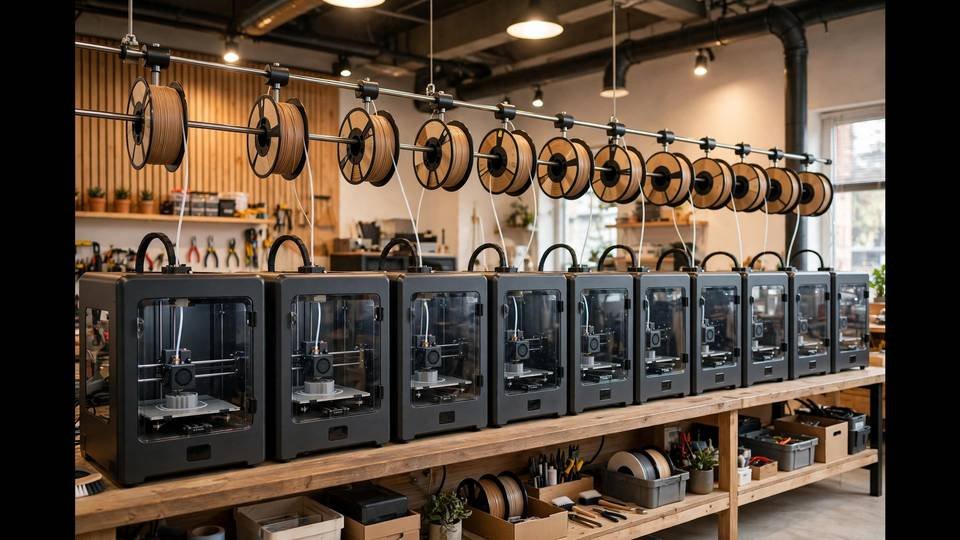
Buy identical machines. This is the golden rule of farming, and beginners break it constantly. A fleet of six identical printers means one set of spare parts, one slicer profile, one set of learned quirks, and any operator (or future employee) can work on any machine. A mixed fleet of six different printers is six times the maintenance knowledge and a quoting nightmare, because the same job takes different times on different machines.
The Bambu question. Bambu Lab machines dominate farm discussions for good reason: they’re fast, they calibrate themselves, and they fail less often than budget machines — which matters enormously when failures cost you paid jobs. The trade-off is higher upfront cost and a more closed ecosystem. Both approaches work — pick based on how much of your own time you want to spend on maintenance.
Start with 2–4 machines. Two printers teach you scheduling, maintenance and quoting without overwhelming you. Four is a serious side business. Beyond that you’re into dedicated space and serious power draw.
The True Cost of a Print (Price This Before Anything Else)
This is where most would-be farm owners go wrong: they price against filament cost and call the rest profit. Filament is typically the smallest cost in a print. Here’s the full build-up for a representative job — a 120 g desk organiser, 6 hours of print time, sold for $25:
- Filament: 120 g at ~$30/kg = $3.60
- Electricity: 6 hours at ~150 W average, at typical Australian rates (~$0.30–0.40/kWh) = roughly $0.30–$0.40. Consumables (nozzles, plates, lubricant) add roughly $0.05–$0.12 per print hour = ~$0.50.
- Machine wear: a $600 printer over ~3,000 usable hours = $0.20/hour = $1.20
- Failure allowance and packaging: even good farms scrap 5–10% of prints (~$0.50), and box, filler and label add $1–$2.
- Your labour: quoting, file prep, monitoring, post-processing, packing — 15–20 minutes at even a modest $25/hour = $6–$8. This is the line everyone sets to zero, and it’s how you end up working for $4 an hour.
- Platform and payment fees: Etsy, PayPal or Stripe take 10–13% all-in on marketplace sales = ~$3 on a $25 sale
Add it up and that $25 sale costs roughly $15–$17 to fulfil — a gross margin around 35–40%, before tax, rent, and the inevitable replacement hotend. That’s workable, but only if you priced every line honestly. Price against filament alone and you’d think you made $21 profit. You didn’t.
Standard pricing formulas used by working print shops: machine time at $2–$5 per print hour, plus $25–$50 per hour for hands-on labour, plus materials at 2–3x cost, with a $15–$25 minimum order value — because quoting and handling a tiny job costs nearly as much as a big one.
Space, Power and Fire Safety (The Australian Bits)
A farm is an industrial-ish activity in a residential setting. Sort the safety and legal bits before you scale, not after something goes wrong.
Fire safety
This is the big one. Printers run 200 °C+ heaters for hours, unattended, and thermal runaway — while rare on modern machines with proper firmware protection — is the nightmare scenario. Non-negotiable measures:
- Smoke detectors and an extinguisher in the print room — detectors tested regularly (a smart one that alerts your phone is ideal), plus a dry powder or CO₂ extinguisher by the door. Know how to use it.
- Never run printers on flammable surfaces. Metal shelving or concrete floors, with clearance around each machine. Keep filament, cardboard and packaging away from the printers.
- Smart plugs with power monitoring let you kill power to a misbehaving printer remotely and alert you to abnormal draw.
Power
Each printer draws roughly 100–350 W while printing (higher during heat-up). Four printers running simultaneously can pull 1–1.5 kW sustained — fine on a normal circuit, but don’t stack them all on one overloaded power board. Past 6–8 machines, talk to an electrician about a dedicated circuit.
Ventilation and fumes
PLA and PETG are low-emission, but a room full of printers still needs airflow — and ABS/ASA printing releases styrene, which needs proper extraction to outside. If your farm will run engineering materials regularly, plan ventilation before you scale, not after.
Insurance, lease and business registration
Check your home and contents insurance — running a business with heat-generating equipment from home can affect coverage, and you may need to disclose it. If you rent, check your lease for commercial activity clauses. Public liability insurance is worth having the moment you sell to strangers. On the admin side: selling regularly with intent to profit generally means you need an ABN (free to register), proper records from day one, and GST registration past $75,000 annual turnover. Keep business money in a separate account from the start.
Where the Work Comes From: Platforms and Channels
Etsy and online marketplaces
Etsy is the classic channel for printed products — cosplay props, planters, organisers, hobby accessories, personalised gifts. It works, but go in with open eyes: fees run 10–13% all-in and competition is global. Successful Australian sellers often win on fast local shipping — a buyer in Perth would rather pay a little more than wait three weeks from overseas.
Airtasker and local services
Airtasker is underrated for print services. Australians regularly post tasks like “3D print this replacement part” or “print 20 of these for my business” — local, practical jobs with less competition than Etsy. Set up a clear tasker profile with photos of your work and example pricing.
Direct local business
The highest-margin work is usually local and B2B: prototypes for engineers and inventors, jigs and fixtures for tradies, replacement parts for businesses with obsolete equipment, architectural models. This work pays better because it’s valued on solving a problem, not on competing with the cheapest global listing.
Your own products
The most scalable model isn’t selling print time — it’s selling products you designed. A clever organiser, a niche hobby accessory, a genuinely useful gadget: design it once, print it a thousand times. Margins are better and you’re building an asset. Many successful farm owners end up here eventually, using service work to fund product development.
Realistic Income Expectations
Let’s be blunt: a widely used benchmark from working farm owners is at least $2–$3 AUD profit per print hour per machine while it’s running, after all costs. That’s the number that tells you whether a job is worth the machine time. Anyone planning to start 3D print farm business Australia operations should memorise this number — it cuts through every fantasy about effortless passive income.
Run the maths on a 4-printer farm: 4 machines × 12 productive hours a day × $2.50/hour profit × 25 days a month = $3,000/month gross profit — if you keep the machines fed with work at that utilisation, which is the hard part. Real farms ramp slowly: expect months of building clientele before utilisation gets healthy. These are the kinds of numbers that decide whether you can realistically start 3D print farm business Australia-style, or whether the machines should stay a hobby a little longer.
Honest ranges for Australian side-business farms:
- 1–2 printers, evenings and weekends: $200–$800/month profit once established — nice hobby income, not a living.
- 3–6 printers, serious side business: $1,000–$4,000/month profit with good utilisation and honest pricing.
- 10+ printers: potentially full-time income, but now you need dedicated space and serious systems — a different game entirely.
The farms that fail usually fail on pricing (charging filament-cost-plus-a-bit and working for nothing), on customer acquisition (great printers, no marketing), or on burnout (saying yes to every low-margin job). The farms that survive price honestly, specialise, and treat it like a business from day one.
Scaling Sensibly: The Playbook
- Prove the model on one printer. Take paid jobs, price them properly using the full cost build-up, and see if the work keeps coming. If you can’t keep one printer busy profitably, more printers won’t fix it.
- Reinvest profits into printer two, then three. Let the business fund its own growth. Each new machine should be identical to the last.
- Systematise before you scale further. Standard quoting template, standard slicer profiles, labelled filament storage, a maintenance log per machine. Chaos scales badly.
- Specialise. “We print anything” competes with everyone. A clear niche gives you repeat customers and pricing power.
- Separate the money. Business account, proper records, ABN from the start.
- Know your ceiling. Decide in advance what “big enough” looks like — four machines funding holidays, or a commercial unit with staff. Both are valid; drifting without a target isn’t.
Growing a farm pairs naturally with levelling up your making skills generally — our filament guide is worth a read if you’re choosing materials for customer work, where the wrong filament choice becomes a warranty problem instead of just a learning experience.
Start 3D Print Farm Business Australia: FAQs
How many 3D printers do I need to start a print farm?
Start with 2–4 identical machines. Two printers teach you scheduling, maintenance load and quoting without overwhelming you; four is a serious side business. Almost no successful farm started with ten machines — they grew from profits, adding identical printers as demand justified them.
How much can you make with a 3D print farm in Australia?
A realistic benchmark is $2–$3 AUD profit per print hour per machine after all costs. A 1–2 printer side setup typically earns $200–$800/month profit once established; a 3–6 printer farm with good utilisation can reach $1,000–$4,000/month. Income depends far more on pricing discipline and customer acquisition than on printer count.
How should I price 3D printing jobs?
Price the full cost: filament, electricity, machine wear ($0.20–$0.45/hour), consumables, a 5–10% failure allowance, your labour time ($25+/hour for handling and finishing), packaging, and platform fees (10–13% on marketplaces). Common shop rates are $2–$5 per machine hour plus labour, with a $15–$25 minimum order. Never price on filament cost alone.
Do I need an ABN to sell 3D prints in Australia?
If you’re selling regularly with intent to profit, yes — get an ABN (free to register) and keep proper records from day one. GST registration becomes mandatory past $75,000 annual turnover. Also check your home insurance and lease regarding business activity, and consider public liability insurance once you’re selling to strangers.
What is the best printer for a 3D print farm?
The best farm printer is cheap, identical to your other machines, reliable, and well-supported in Australia. Popular choices include the Bambu Lab A1 (~$600–$700) for reliability and speed, the P1S (~$900–$1,000) where enclosed printing is needed, and budget options like the Ender 3 V3 SE (~$260) or Elegoo Neptune 4 (~$300–$360) for low-capital fleets. Buy identical machines — a mixed fleet multiplies maintenance headaches.