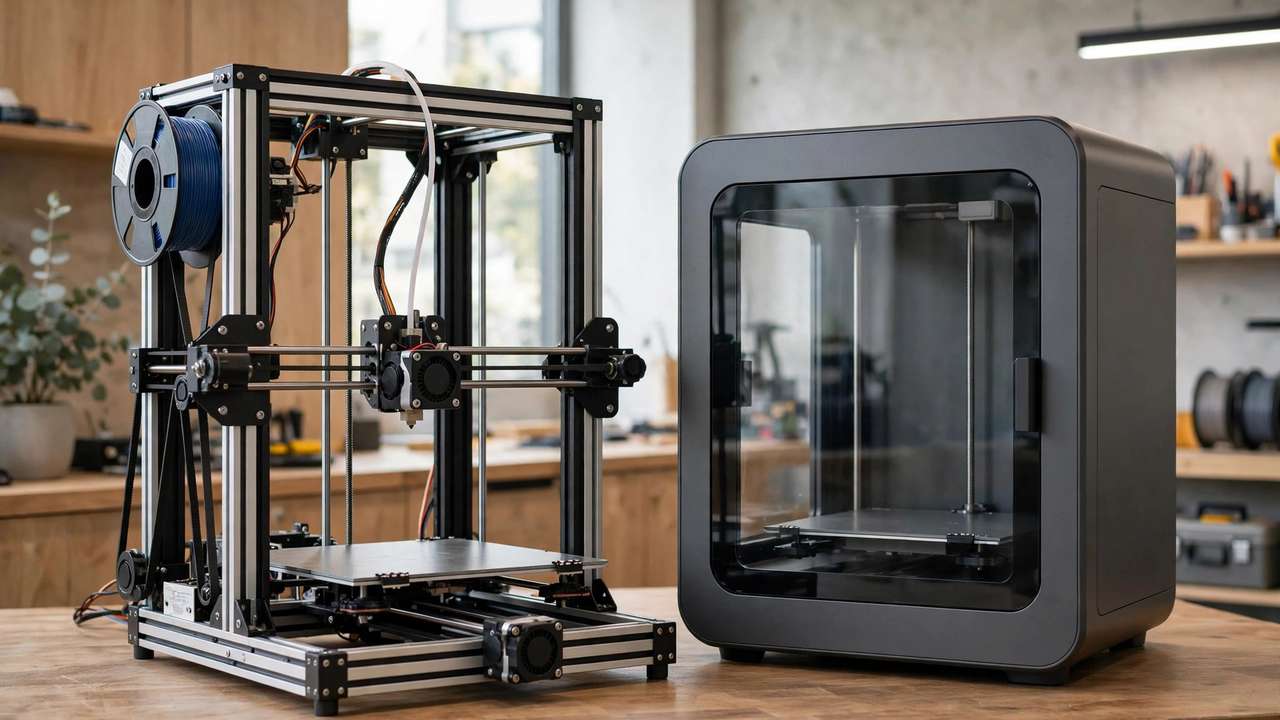
If you’ve been circling the “what printer next” question, you’ve probably landed on Voron vs Bambu Lab as the two answers everyone keeps shouting. One crowd says build a Voron and you’ll never want another machine. The other says buy a Bambu Lab and be printing perfect parts tonight. Both are telling the truth — just not the whole truth.
This is the comparison for Australian makers who want the full picture: what each path costs once parts land in Sydney or Perth, how the printing experience differs day to day, and who each option genuinely suits. No fanboyism — both ecosystems have sharp edges the marketing hides.
What Voron Actually Is
Voron isn’t a company that sells printers. It’s an open-source project — Voron Design, founded in 2015 by Maksim Zolin — that publishes free specifications for high-performance CoreXY 3D printers. You don’t buy a Voron. You build one: either by ordering every part yourself from the official bill of materials, or by buying a kit from a third-party supplier and assembling it.
That’s the first thing to understand, because it shapes everything else. There’s no Voron support desk and no warranty on the printer as a whole. What there is, instead, is a massive community — a Discord server with tens of thousands of members, forums, and midnight debugging help. By 2025, the community estimated more than 15,000 Vorons had been built worldwide.
The printers themselves helped push the whole industry forward. Voron, alongside projects like Rat Rig’s V-Core and the VzBot, popularised CoreXY motion in the hobby space, and its use of the open-source Klipper firmware — with input shaping and pressure advance — brought high-speed printing into the mainstream well before the big brands caught up.
The Current Voron Lineup
Voron publishes four mainstream designs, with official USD cost estimates that exclude tools and shipping:
- Voron 0.2 (V0.2r1) — a tiny 120 × 120 × 120 mm desktop cube. The cheapest entry point at roughly $400–600 USD in parts, but cramped to assemble.
- Voron Trident — a full-size CoreXY with a fixed gantry and three-leadscrew moving bed. 250, 300 or 350 mm bed sizes (Z tops out around 250 mm). About $1,000–1,300 USD, and the easiest full-size Voron to build.
- Voron 2.4 (V2.4r2) — the flagship. Enclosed CoreXY with a static bed and a “flying gantry” that moves in Z, levelled by four-point gantry tramming. Sizes from 250 × 250 × 220 mm up to 350 × 350 × 330 mm. Roughly $1,500–1,900 USD. Most parts, most drivers (seven), longest build.
- Voron Switchwire — a CoreXZ “bed slinger” conversion, roughly $700–900 USD without a donor printer to pull parts from.
Expect 25 to 50 hours for the build. The plastic parts must be printed in ABS or ASA (the designs assume parts that survive a heated chamber), so many builders print them on a friend’s machine or buy pre-printed part sets — a real cost people forget to budget, often a couple of hundred AUD.
This Voron vs Bambu Lab comparison is for makers deciding between a project and a product.
What Bambu Lab Puts on Your Desk
Bambu Lab is the opposite bet. Founded in mid-2020 by five ex-DJI engineers, the company launched the X1 on Kickstarter in May 2022 — raising over $7M USD from 5,500+ backers — and has since become the dominant name in consumer 3D printing. Where Voron hands you plans and a parts list, Bambu Lab hands you a box.
The current lineup covers the whole price ladder:
- A1 Mini — a compact 180 mm open-frame bed slinger. The easiest first printer on the market and the cheapest way into the ecosystem. Around $319 AUD machine-only or roughly $529 AUD with the AMS Lite four-colour unit at Australian retailers like CD Soft.
- A1 — the same recipe scaled to a 256 mm cube, with full auto-calibration and quiet operation. Around $427 AUD machine-only or about $649 AUD as a combo with the AMS Lite at retailers like Core Electronics.
- P1S — the enclosed CoreXY workhorse. Same print quality as the flagship line for PLA and PETG, and the natural pick for printing ASA or ABS without fumes drifting through the house. Around $819 AUD when available — stock has been thinning as the newer P2S takes over, so check current pricing.
- X1 Carbon — the flagship. Enclosed CoreXY with a carbon frame, chamber cooling, AI spaghetti detection and hardened components. Around $1,149 AUD at Australian retailers. The machine you buy when downtime costs you money.
The Bambu formula is consistent across the range: automatic bed levelling, vibration compensation, filament runout sensors, a camera for remote monitoring, and the AMS / AMS Lite system for multi-colour printing — our guide to the best multicolour 3D printers breaks down how the AMS approach compares. You slice in Bambu Studio (or OrcaSlicer), hit print from your phone with Bambu Handy, and the machine handles the rest. Assembly is measured in minutes.
Voron vs Bambu Lab: The Real Cost Comparison
This is where the debate usually goes sideways, because people compare a Voron’s parts cost to a Bambu’s sticker price and call it a day. Here’s a fairer way to think about it for an Australian buyer.
A Voron 2.4 (350 mm) built from a decent kit lands around $1,500–1,900 USD in parts per the project’s own estimates — roughly $2,300–2,950 AUD before shipping, import charges and the inevitable “wrong rails” second order. Add printed parts if you can’t print them yourself, plus 25–50 hours of your time. The true cost of a Voron 2.4 is comfortably over $3,000 AUD once your time counts for anything. A Trident runs around $1,550–2,000 AUD in parts; a V0.2 can sneak under $1,000 AUD all-in.
A Bambu Lab X1 Carbon costs about $1,149 AUD from a local reseller and prints its first part the same evening. A P1S at around $819 AUD covers enclosed printing for hundreds less. Even an A1 combo at ~$649 AUD gives you multi-colour printing for less than a Voron 0.2 build.
On pure dollars, Bambu Lab wins, and it isn’t close. The honest counterargument is that you’re not buying the same thing: a well-built Voron 2.4 is a machine you fully understand, can repair with generic parts forever, and can upgrade indefinitely. A Bambu is a product with a warranty and a supply chain.
One more cost wrinkle: clones. The Sovol SV08 is essentially a Voron 2.4 clone, and the Troodon 2.0 follows the same formula — factory-assembled machines borrowing Voron’s open designs. They sit in the middle ground, though quality control on clones is its own lottery.
Total cost of ownership is where the Voron vs Bambu Lab decision often gets made.
Voron vs Bambu Lab: Print Quality and Reliability
A properly built, well-tuned Voron 2.4 prints beautifully — fast and precise, with surface quality matching anything in its class. Klipper’s input shaping lets it push high accelerations without ringing, and because you chose every component, you know exactly what the machine can do. The ceiling is high.
But that ceiling has a trapdoor: you are the quality control. A Voron prints as well as it was built and tuned. Misaligned rails, a slightly off-square frame, or lazy input-shaper tuning will show up in every print until you fix them. Many builders spend their first month chasing small issues, and plenty enjoy that process. If you don’t, it’s miserable.
A Bambu Lab printer, by contrast, prints well on day one and keeps printing well with minimal intervention. Auto-calibration handles bed levelling, flow dynamics and vibration compensation before every job, and when something does go wrong, the failure modes are standardised — the fix is usually documented. For reliability-per-dollar, the P1S and X1C are hard to argue with.
Where Voron claws back ground is long-term reliability. A Voron has no proprietary parts: every rail, motor and board is a standard component you can replace from a dozen suppliers. In five years, when Bambu has moved through two more product generations, your Voron is still fully serviceable and probably running newer firmware than the day you built it.
Community vs Customer Support
Voron’s support is its community, and it’s extraordinary — the Discord, the forums, the build guides, the mods. But community support is asynchronous, uneven, and occasionally blunt. If your printer is down and you’re losing money on a deadline, “ask the Discord” is not a service-level agreement.
Bambu Lab offers actual customer support, a warranty, and a parts store. Response quality varies — anyone who’s been through a warranty claim with a fast-growing hardware company knows the drill — but the channel exists. Australian buyers also get local resellers like Core Electronics and 3D Printer Superstore: GST-inclusive pricing, local stock, and someone in your timezone when a package goes missing. The Bambu community is also broader and more beginner-tolerant than Voron’s docs-first culture — built for different people, neither better.
Materials, Enclosures and Openness
Here’s a practical divider. A Voron 2.4 or Trident is enclosed by design, with chamber temperatures that handle ABS and ASA comfortably and room to grow into nylon and polycarbonate with the right hotend. You choose every component — hotend, extruder, board, firmware.
Bambu’s enclosed machines (P1S, X1C) print ABS and ASA well out of the box, and the X1 Carbon handles nylon and PC with its hardened nozzle and hotend. The catch is the ecosystem: Bambu’s RFID-tagged filament spools, cloud-connected workflow and firmware are a walled garden. It works smoothly inside the walls — most users never feel them — but you’re renting convenience from one company. Third-party filament works fine, but the deeper you go into the Bambu workflow, the more you’re tied to Bambu’s decisions.
Voron runs Klipper and whatever slicer you like — OrcaSlicer is the community favourite, and our Cura setup walkthrough covers slicer-tuning fundamentals that carry over to any machine. You own the whole stack: liberating if you’re technical, a burden if you’re not.
Which One Should You Actually Buy?
Forget the tribalism. Here’s how the decision actually breaks down:
- Buy a Bambu Lab if: you want to print things, not build printers. You’re a beginner, a designer who needs prototypes, a small business owner who needs output, or a hobbyist whose free time is scarce. An A1 is the best-value entry point in Australia right now; a P1S is the sweet spot for enclosed printing; the X1 Carbon is for people who print daily and hate downtime. If you’re still weighing cheap first printers generally, our budget 3D printer guide for 2025 puts the A1 Mini in context.
- Build a Voron if: the build is the hobby, at least partly. You enjoy tinkering, you want to understand your machine down to the last belt, you print engineering materials regularly, or you want a machine that never goes obsolete because you can rebuild it forever. Pick the Trident for the sanest first build, the 2.4 for the flagship experience, or the V0.2 as a fun second machine.
- Consider both if: you’re a serious hobbyist with room on the bench. Plenty of makers run a Bambu as the daily driver and a Voron as the project machine — no single printer does everything.
The question was never really “which printer is better.” A Voron 2.4 and a Bambu X1 Carbon are both excellent machines that arrive at excellence from opposite directions. The real question is which kind of maker you want to become — buy the machine that matches, and you’ll be happy.
Frequently Asked Questions
Is a Voron better than a Bambu Lab printer?
Neither is objectively better — they optimise for different things. A well-built Voron 2.4 offers more customisation, full repairability with generic parts, and a higher ceiling. A Bambu Lab X1 Carbon or P1S offers comparable print quality out of the box with a fraction of the setup effort.
How much does it cost to build a Voron 2.4 in Australia?
The Voron project’s own estimate is $1,500–1,900 USD in parts (roughly $2,300–2,950 AUD), excluding tools, shipping and printed parts. With freight and re-orders, most Australian builders spend well over $3,000 AUD — plus 25–50 hours of build time.
Can a beginner build a Voron?
A determined beginner can, but it’s a serious undertaking — basic electronics skills (crimping, wiring mains power safely), mechanical patience, and comfort with long technical manuals. Most first-time builders budget several weekends. If you’ve never owned a 3D printer, starting with a ready-to-run machine like a Bambu A1 and building a Voron as a second project is the path most of the community recommends.
Does Bambu Lab ship to Australia, and what about local support?
Yes — Bambu Lab sells in Australia directly and through authorised resellers such as Core Electronics and 3D Printer Superstore, with GST-inclusive AUD pricing and local stock. Buying from an Australian reseller generally means faster delivery and easier warranty handling.
Which is better for printing ABS and ASA?
Both handle them well. The Voron 2.4 and Trident are enclosed by design and were essentially built for ABS/ASA, with headroom for hotter materials like nylon. The Bambu P1S and X1 Carbon print ABS and ASA reliably out of the box. The Voron gives you more room to push into exotic materials; the Bambu gets you printing ASA on day one.